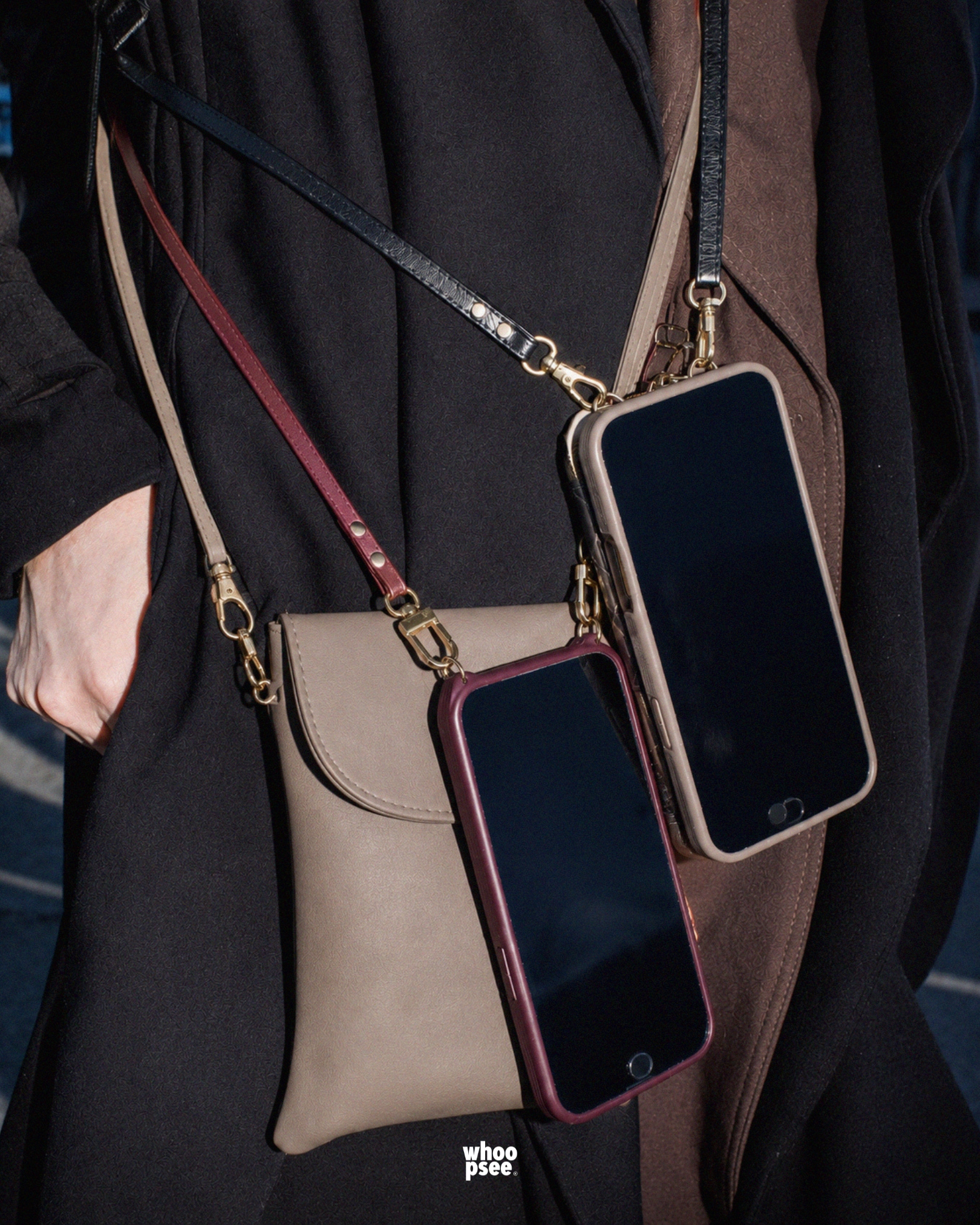
A New York Times carousel recently brought to light, through a series of photographs taken on the streets of New York City, an increasingly recognizable phenomenon: passersby holding two iPhones, accompanied by a prominent caption that seems almost provocative: “the new must-have accessory would be…owning two phones.” Beyond the comments underneath the post, which are clearly ironic in tone (among those that made me smile the most: “maybe it’s time to touch some weed” and another even more direct, “no, I’d just like health insurance”), the images nonetheless tell of an increasingly widespread reality.
Today, in fact, it is increasingly common for two devices to coexist: one dedicated to private life and one to work. Personal messages, organization of leisure time and everyday life on the one hand; emails, calls on Google Meet and Excel sheets and professional activities on the other. Two separate digital ecosystems that mark and, at the same time, overlap in our days. The separation of private and work life has become one of the central themes of the present, often also a source of tension when the boundaries between the two worlds become porous. But what the New York Times highlights is not just the proliferation of devices. Rather, the paradigm shift is interesting: after years of progressive miniaturization and the merging of functions into a single multifunctional device, a new trend toward separation seems to be emerging. Screens are larger, accessories are bulkier, and most importantly, it is no longer uncommon to find oneself with two or even three phones at hand.
It may seem counterintuitive, but many of those who choose this configuration see it as a healthier solution-a way to define clearer boundaries between work and private life. However, “multiphone” life also entails a very concrete and less theoretical consequence: the need to physically carry all those devices with you. And everyone, in his or her own way, contrives to manage it. From stacked solutions to overloaded pockets to specially designed accessories, urban everyday life adapts to this new form of dual (or triple) digital identity. This newfound materiality therefore also has, as is often the case, its own aesthetic paradigm. After years of subtraction, invisibility and technological optimization – increasingly thinner, minimal devices that aimed for maximum efficiency in the smallest possible forms – an opposite trend seems to be reasserting itself: larger objects, larger screens, much more present and irreverent accessories and useless basic gadgets, in a kind of general “maxxing” of technology and digital experience.
It is a movement that is not only about function or the idea of status (remember, of course, that these are all accessories and fixtures linked to a certain economic well-being; this discourse can also be placed within a paradigm of consumerism in which the more one shows, the more one belongs to a certain social class) but also about form and its perception. And like any aesthetic and cultural oscillation, it rarely proceeds in a straight line: trends move in waves, alternating between accumulation and subtraction, exuberance and reduction. In this sense, the return of the “double phone” is perhaps not an end point, but an intermediate stage. If today we are witnessing a new emphasis on separation and multiplication of devices, it is plausible to imagine that the cycle may again reverse itself, bringing back to the forefront a form of technological minimalism, perhaps more self-conscious, less naïve than the previous one.
Between these two poles, what really changes is not only the number of objects we carry with us, but the way we choose to inhabit the digital: between control and overload, synthesis and proliferation, in an ongoing even identity-based reflection on how much technology says about us.