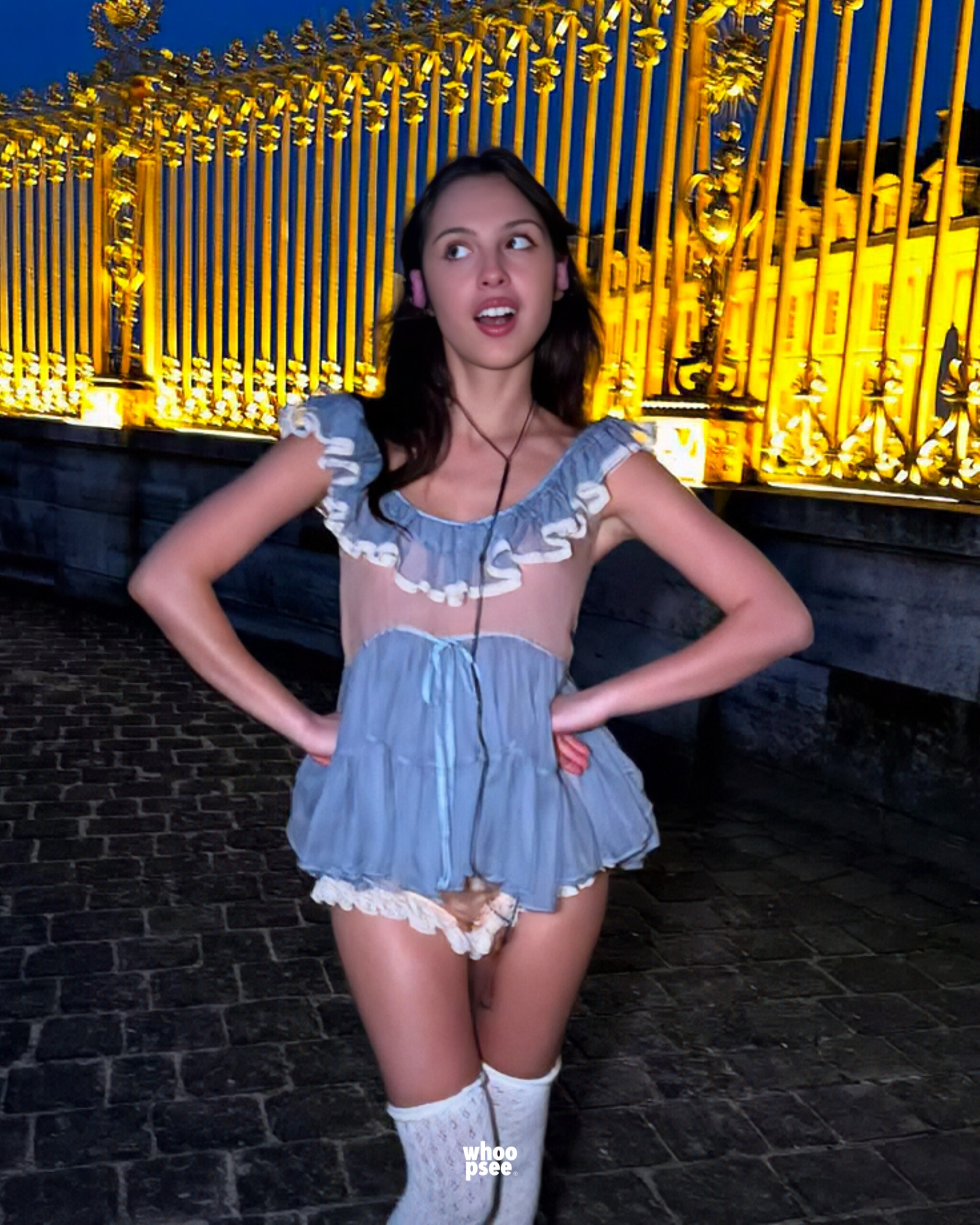
In recent days we are witnessing a heated online debate around the babydoll sported by Olivia Rodrigo. On Saturday in Barcelona, in fact, the singer performed at the Spotify Billions Club in a richly embellished Generation78 signature puff-sleeved top worn without pants. The look was complemented by a pair of knee-high Dr. Martens boots, but the overall allure clearly hinted at the babydoll aesthetic. The same imagery also recurs in the video for the song “Drop Dead” and in several photo shoots done ahead of the new album, titled you seem pretty sad for a girl so in love.
Many online comments criticize this aesthetic choice, arguing that the babydoll – for those who do not place it, a very short dress often associated with doll or childhood imagery, characterized by pastel colors, lace and puffy sleeves – may be infantilizing or contribute to an ambiguous sexualization of an aesthetic perceived as “childlike” and therefore inherently naive. It is not unusual for pop stars to build an entire recording era around distinctive visual imagery, especially when steeped in nostalgia.
However, in Rodrigo’s case, this silhouette has drawn criticism that speaks of “infantilization” or regressive staging of her own image. In fact, the babydoll dress is by no means new, and Olivia Rodrigo is certainly not the only artist to have adopted it. Tracing its history, the dress originated in 1942 in the United States during World War II as a response to fabric shortages. This cut then became popular in the late 1950s and 1960s thanks to icons such as Brigitte Bardot, Twiggy, and Jane Birkin (in the video for “drop dead,” Rodrigo wore just such a party dress that belonged to Birkin.) Even Cristóbal Balenciaga, in 1958, dedicated a haute couture collection to this silhouette.
In the 1990s the dress made a comeback, worn by figures such as Courtney Love and Kim Gordon. It is these grunge and riot grrrl icons who are a major source of inspiration for Rodrigo. As she said in an interview, “I really love the idea of the babydoll dress. I remember when I was younger and seeing pictures of Courtney Love and Kat Bjelland, of all these punk riot grrrl bands, with their babydoll dresses, worn with total confidence.” The references she draws on are thus explicit and consistent, and allow us to read the babydoll not as a mere childish aesthetic, but as a layered cultural device. At its base, in fact, the babydoll dress originates as a gesture of rupture. At its introduction, it opposes the hyper-feminized aesthetic of the 1950s, dominated by narrow waists and structured skirts as in Christian Dior’s New Look. Then, in the 1990s, it takes on an even more subversive meaning: artists such as Gordon and Love use it to create a contrast between the harshness of their music and an overt, undomesticated femininity. In this sense, these women challenge the idea that explicit femininity must necessarily be filtered through the male gaze.
Rodrigo thus fits into this tradition with a more playful and ironic approach. With the help of stylists Chloe and Chenelle Delgadillo, his new era alternates Betsey Johnson or vintage Miu Miu designer babydoll dresses with lived-in military boots or vertiginous Mary Jane’s, constructing a deliberately contradictory imagery. It is also worth noting how this kind of aesthetic is often perceived differently depending on cultural contexts: what in the West may be read as infantilizing or problematic, in other cultures – as in some of the Asian kawaii aesthetic – falls instead into a normalized visual language related to softness and identity-building without necessarily negative implications.
Ultimately, beyond criticism, Rodrigo fits into a long line of female artists who have used the babydoll as a symbol of ambivalence and, often, rebellion. Rather than a naïve adherence to a “naïve” aesthetic, hers is a game of conscious quotation. And, as is often the case with pop stars, the aesthetic becomes a narrative tool: it can be provocative, irreverent, or layered, but it only really works if it is consistent with the musical identity that supports it.
[📷 Instagram: oliviarodrigo]