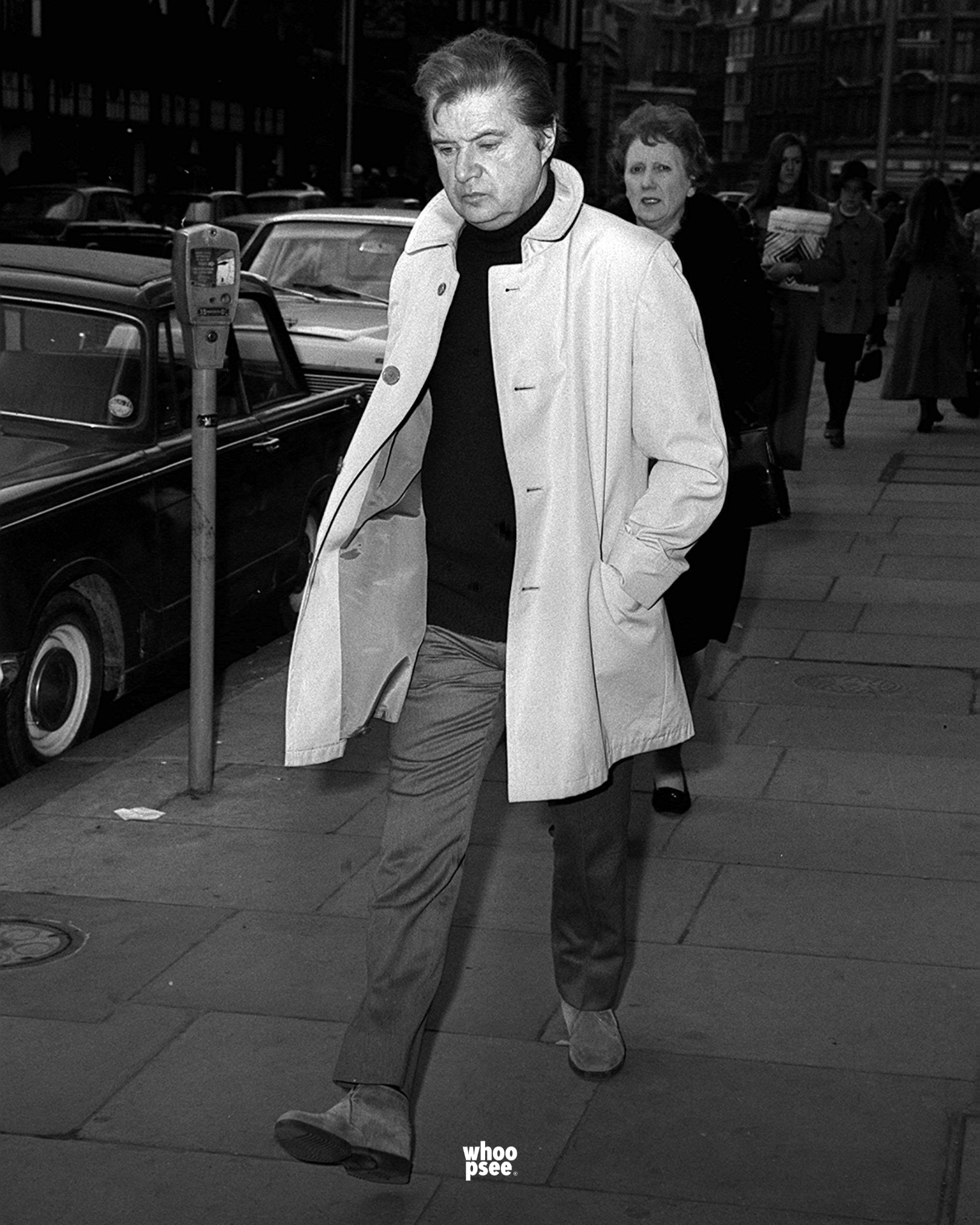
If Mark Rothko embodies the idea of a modern abstractionism now fully assimilated by the widespread taste, also accomplice to a certain aesthetic accessibility of his chromatic surfaces, the case of Francis Bacon appears, in some ways, even more complex. A widely celebrated painter today, Bacon is in fact in danger of being reduced to a purely visual fruition, where the conceptual violence of his work would instead demand quite another depth of reading.
A self-taught artist, Bacon radically redefined figurative painting in the second half of the twentieth century, constructing a language in which the human body, deformed, isolated, often trapped in geometric spaces, becomes the theater of extreme existential tensions. His images, far from being unambiguous, are articulated in a layering of meanings that traverse the fragility, brutality and instability of the human condition. His own biography, marked by excesses, complex relationships and a constant exposure to pain, is reflected in a painting practice of extraordinary emotional intensity.
Bacon spoke of a “serial” vision, and it is no coincidence that his production-about 590 works surviving, compared with numerous destroyed paintings-is developed in cycles, often articulated in diptychs and triptychs. From the earliest subjects of the 1930s, such as the Furies, to the isolated heads of the 1940s; from the famous “screaming popes” of the 1950s to the animal and solitary figures of the same period; from the crucifixions of the early 1960s to the portraits and self-portraits of the following years, up to the most essential outcomes of the 1980s: each phase takes the form of obsessive variation on an iconographic nucleus, rather than linear evolution. On a technical level, too, Bacon introduces a profoundly innovative pictorial grammar: the use of movement, erasure, layering, and a vibrant chromatic matter helps to construct images that elude any perceptual stability. And yet, this very visual force can generate a misunderstanding: as with Rothko, the risk is that the aesthetic impact is isolated from its content, turning radical works into objects of visual consumption.
In this sense, the story of Carlo Ponti and Sophia Loren’s collection offers a significant counterfield. Far from a merely decorative logic, their collection is configured as a high-profile collecting project, capable of bringing into dialogue some of the main languages of the 20th century: from Picasso to Magritte, from Dalí to Braque, from Henry Moore to Barbara Hepworth, up to Giorgio de Chirico and Canaletto, including a relevant nucleus of works by Bacon. Kept at Villa Ponti in Rome-and according to some sources conceived as a gift for Loren-the collection testifies to a critical awareness that is anything but superficial. The 1977 confiscation episode, when part of the works were seized as the couple attempted to move it to Paris, marks the transition from private dimension to public issue. The works involved included paintings by Bacon alongside works by Picasso, Morandi, and Henry Moore. Some of these were later exhibited at the Pinacoteca di Brera in the Bacon at Brera exhibition and forty drawings by Grosz in stopovers in Milan (1982-1983), helping to consolidate the artist’s institutional reception in Italy.
What emerges clearly is the far from neutral nature of large collections: they are configured as cultural devices in which taste, power, desire and risk are intertwined, sometimes producing effects that far exceed the private sphere. Not mere collections, then, but true symbolic constructions, capable of transforming themselves, as in this case, into public narratives full of implications.
Similar depth can be found in the collecting sensibility of Valentino Garavani, who kept a beautiful portrait of George Dyer painted by Bacon in his Paris residence. The work, imbued with emotional tension, restores the complexity of a relationship marked by dependence and tragedy, and fits perfectly into that dimension of pathos and awareness that makes Bacon’s painting irreducible to any superficial reading.
[📷 IPA]