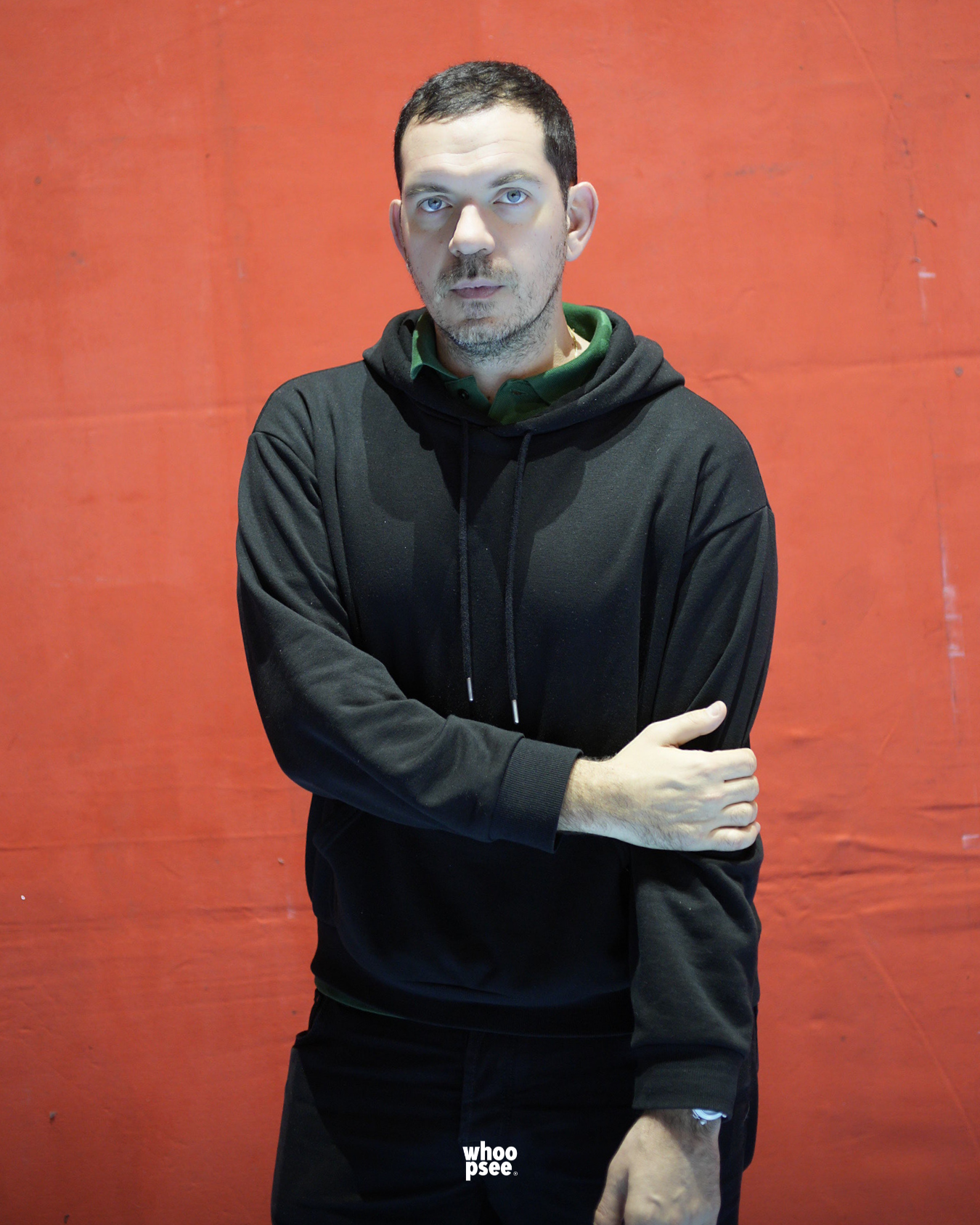
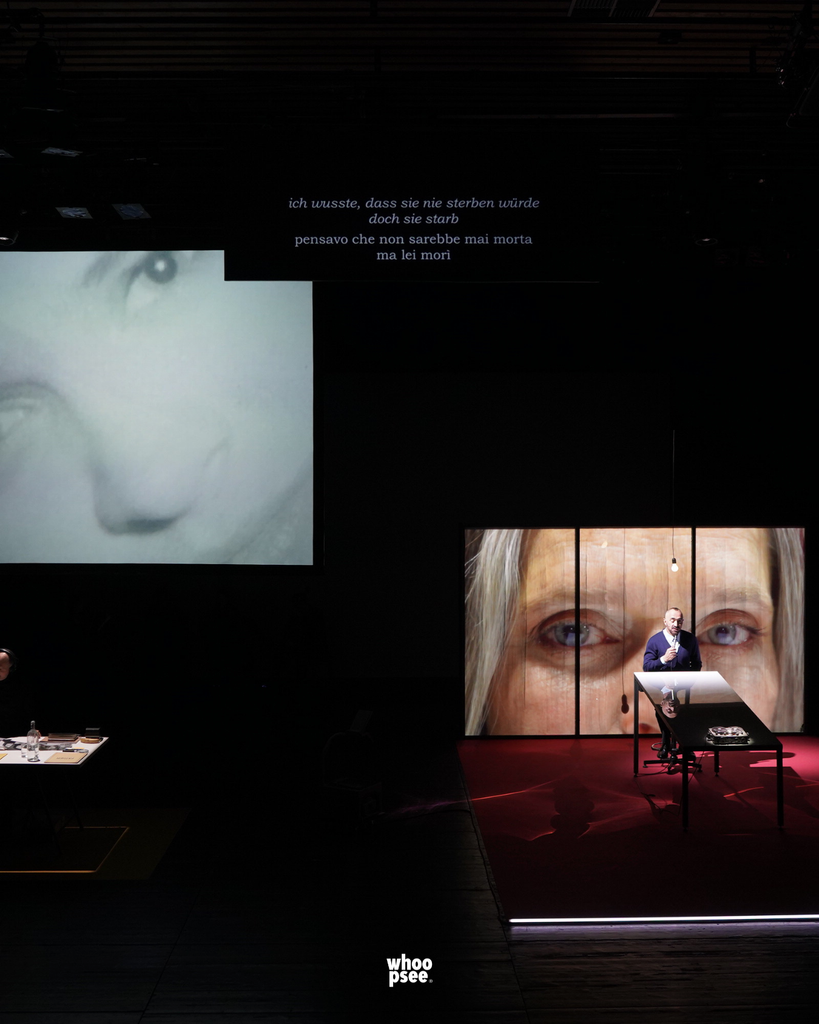
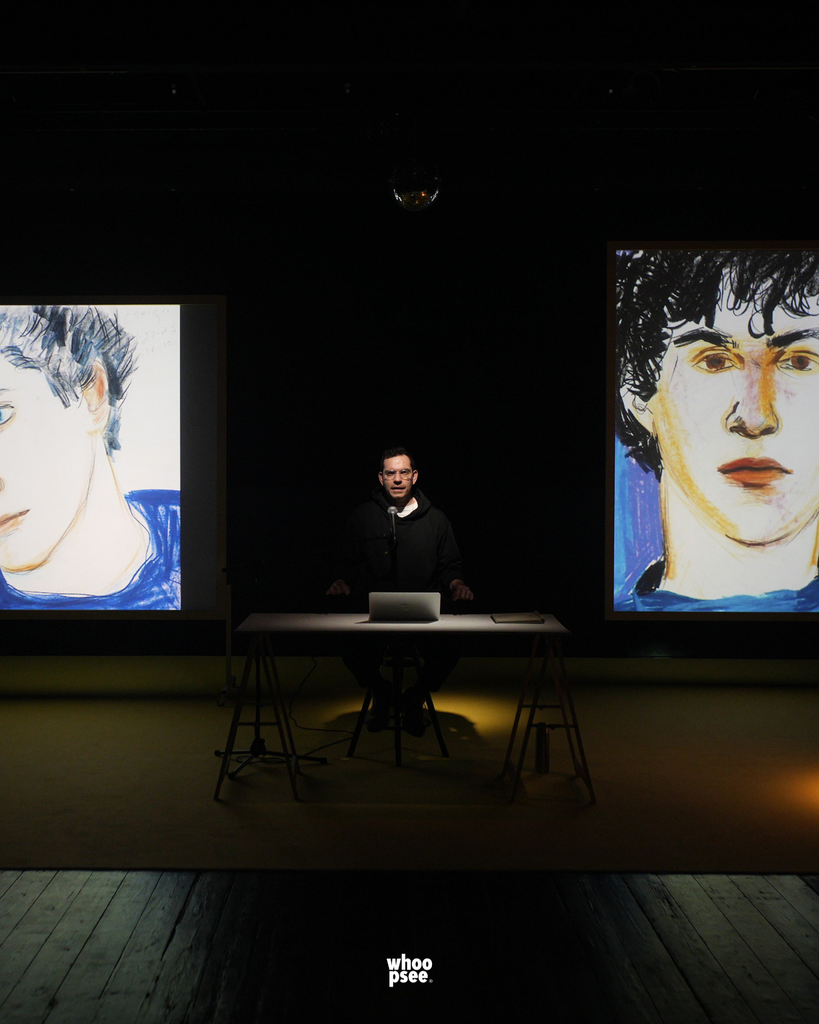
One cold March evening—if I’m not mistaken—a dear friend took me to the Triennale. In addition to being a friend, he is an artist I deeply admire, not only for his work but for that rare ability to continually open up new perspectives, to suggest connections and paths that might otherwise go unnoticed. It’s one of those friendships that, over time, ends up becoming a form of education in how to see: every encounter leaves something behind—a thought-provoking idea, another way of looking at things. That evening, we went to see *A Visual Diary*, a work by Fabio Cherstich dedicated to the New York queer scene of the 1980s and, in particular, to the stories of three underground artists: Patrick Angus, Larry Stanton, and Darrell Ellis. Through photographs, archival documents, interviews, and audiovisual materials, Cherstich reconstructs their lives and the artistic and human context in which they unfolded, recounting the story of a community marked by creativity, desire, and the search for a place to belong—but also by the violence of social invisibility and the AIDS epidemic. The work stems from research conducted in the United States and occupies that borderland between theater, storytelling, documentary, and art history that runs through Cherstich’s practice. *A Visual Diary* will return to New York in September, be presented in Paris at the Pinault Collection in November, and then head to Berlin, at the Volksbühne, in January 2027. This international trajectory takes a work born in the theater to contexts and institutions belonging to different cultural worlds, confirming its cross-disciplinary nature. Once again, my dear friend had taken me to see something special—an experience that left a lasting impression on me and sparked my desire to contact Cherstich for this interview.
His work, in fact, wasn’t entirely new to me. Perhaps my first encounter with one of his works dates back to October 2025, when, in Paris during Art Basel, I saw a choral performance he created with the artist Helen Marten in collaboration with Miu Miu. As I delved deeper into his career, Cherstich (1984) can be described—with great flexibility in terms of labels and categorizations—as a director and set designer for theater and opera. His practice explores the relationship between the visual arts, performance, and contemporary culture, developing a language characterized by strong formal rigor and a multidisciplinary approach that weaves together theater, opera, the visual arts, and exhibition practices. Over the years, he has directed and designed sets for major international institutions, including the Mariinsky Theatre in St. Petersburg, the Teatro Massimo in Palermo, the Teatro dell’Opera in Rome, the Opéra d’Avignon, the Opéra de Marseille, the Théâtre Maillon in Strasbourg, the Teatro Argentina in Rome, and the iTeatri in Reggio Emilia. His works have also been presented at international festivals such as the Festival d’Avignon, the Napoli Teatro Festival, Premières Strasbourg, the STUK Arts Center in Leuven, and the Venice Theater Biennale. Cherstich is also the creator and artistic director of Operacamion, the traveling project dedicated to bringing opera to new audiences, described by The New York Times as “a unique project capable of bringing opera back to its roots.” Operacamion is also the subject of a “Case for Culture” at Harvard University, where it is studied as an innovative model for access to culture and the promotion of opera in public spaces. Alongside his theater work, Cherstich creates performance projects for the fashion and design sectors, collaborating with brands such as Saint Laurent, Miu Miu, Hermès, Cassina, Gufram, Memphis Milano, Fay, Off-White, Jacob Cohen, and Acne Studios. Since 2019, he has curated *The Estate of Larry Stanton – NYC*, a research and exhibition project dedicated to rediscovering the work and cultural context of the American artist Larry Stanton, on which the performance I saw at the Triennale is partially based.
And it was precisely that work, *A Visual Diary*, that sparked the curiosity that gave rise to this conversation: the desire to gain a deeper understanding of a body of work that spans such diverse languages, disciplines, and contexts.
You are a director, set designer, and curator. The question is: How do you approach physical space when you think about the setting, the body, sound, and, last but not least, the audience?
Space is not merely the container of a story; it is already a drama written by someone else before me: an Italian-style theater imposes a hierarchy of gazes upon you, a deconsecrated church imposes a direction, and a square imposes noise. I almost always start by understanding what that place is already saying, and by deciding whether to go along with it or contradict it. For me, the body and sound are one and the same: both define a volume. Sound does so before light and before the stage, because when you walk into a hall, you understand how big it is with your ears. So very often I start there. The audience isn’t just the recipient of the work—it’s a material of the work. With *Operacamion*, I learned this the hard way: you open the sides of a truck in the suburbs, and the audience isn’t sitting in the dark watching an opera they’ve subscribed to—they’re standing, at your eye level, with their children, their dogs, and their phones. It’s impossible to ignore them. Ever since then, even when I’m working surrounded by the comfortable velvets of theaters, I always ask myself where the stage ends and the auditorium begins—and the answer is almost never the proscenium.
If you had to describe your work with a single image, what would it be? Or maybe not even an image: a sound, an object, a text.
I identify with Grotowski’s definition of the director as a professional spectator: the actor’s first spectator. It is a technical, not a poetic, definition, and it has a specific implication for the method. My expertise is both expressive and perceptive: it consists not only in producing signs, but in verifying whether an action reaches its audience, at what distance, and with what delay. For this reason, my primary tools during rehearsals are direction, positioning, and the point of view from which I observe—both practically and metaphorically. The material I look at first, then, is almost always someone else’s, and this applies both to the theatrical and operatic repertoire and to the curatorial work related to the archives of the visual artists I work with: a score by Puccini, Verdi, or Mozart; a painter’s body of work; a box of photographs kept for forty years by a friend or relative. I come later, and my responsibility lies in how that material is read—in the sense of interpreted—so that it can then be presented anew.
What does it mean to do theater today? I’ve always questioned the term “contemporary.” What does it mean to stage a Puccini opera today? Does it make sense to say that you’re “making it contemporary”?
No, it doesn’t make sense, and I’m extremely wary of that word. “Modernizing” usually means making a substitution: the court becomes a board of directors, soldiers become police officers, and in the end you’ve simply translated one symbol into another, with the result that the audience spends the evening playing a matching game instead of listening to the music. An opera doesn’t need to be modernized—it needs to be taken seriously. Puccini is already a frighteningly modern playwright, so the question I ask myself isn’t “how do I make this relevant today?” but “what do I see, today, when I watch this, that I simply cannot ignore?” Take *Madama Butterfly*: it’s the story of a Western man who buys a fifteen-year-old girl, and pretending not to know that is no longer possible. There’s no need to set it in the present; what’s needed is not to water it down. Relevance isn’t a setting—it’s a level of honesty.
On the role of theaters today. Cultural elitism, the idea that theater is “for old people” (just a few months ago, there was an uproar over Chalamet’s comments). Are these questions you ask yourself?
I’m less interested in the controversy surrounding Chalamet than in the underlying question. Elitism isn’t just a matter of repertoire and culture—which you need to some extent to understand or delve deeper into the subject—it’s also, and above all, a matter of a threshold. How much it costs, who welcomes you, how you’re supposed to dress, whether you understand the unwritten rules. With Operacamion, I saw this firsthand: people who had never set foot in a theater would stop and stand there for an hour listening to Mozart. Not because we’d simplified it, but because we’d removed the door. When I start a project, I always ask myself this: not “how can I be young”—which is the saddest question in the world—but “who feels empowered to come in here.” And then there’s a fact that no one ever mentions: older audiences are often the freest. They’re the ones who boo you the most—and thank goodness for that, I say.
How important is language in your work? I’m talking specifically about words—from the written text to the titles you choose for your shows.
Language is at the heart of everything. I have a less reverent approach to the spoken word on stage than one might expect from a theater director: the text isn’t something to be illustrated; it’s one of the elements, on par with light and sound. However, when words are present, they must be precise and understandable. They are tools. What really interests me is the fusion of registers that don’t usually coexist in the same space. In *Operacamion*, Mozartian recitative coexisted with the language of a neighborhood festival. In *30 Blizzards*, with Helen Marten for Miu Miu in Paris, singing and spoken word alternated in a libretto she wrote that the audience held in their hands: they read and watched together, as in an opera, but without a story to follow. In Cremona, with Guglielmo Castelli, the starting point was one of his nursery rhymes—a childlike, mnemonic form—and from there we arrived at the madrigal: two vastly different languages that come together because both rely on short lines and repetition. With David Lang, in *A Note to a Friend*, the source material was texts by Kawabata: Japanese prose, contemporary American music, and European theater. Three grammatical systems that correct one another. Then there’s the title, which I consider the first element of the staging: it’s the first thing the audience encounters—often months in advance—and it determines the expectations with which they enter the theater. *A Visual Diary* is in English and deliberately understated, almost like a museum caption: it promises a document rather than an emotion, and this allows the emotion to arrive unannounced. *Sospeso nel moto con addebito di vuoto* works in the opposite way, because it contains an accounting term, “addebito,” which in a church sounds like an error in the ledger. That error is already the project itself.
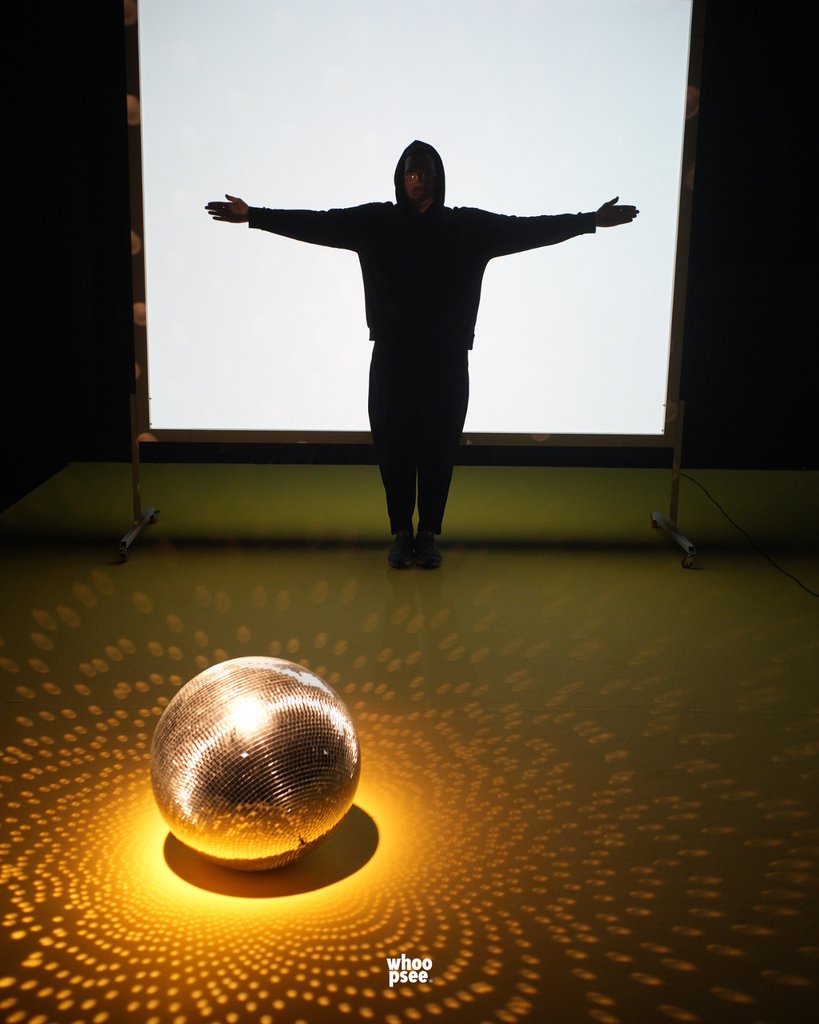
I’d like to talk about props. How do you transform an inanimate object into a “partner” on stage? How do you integrate three-dimensional stage elements into the movement so that they’re not just part of the backdrop? I’m thinking of the performance with Miu Miu that I saw in Paris.
An object on stage is never inanimate: it has a weight, a handling time, and a sound it makes when you set it down. These are all dramaturgical elements. The moment a performer stops “using” an object and begins to negotiate with it is the moment the scene comes alive, because the object has needs, and those needs are the only thing that generates true action. In my collaboration with Goshka Macuga for Miu Miu Tales & Tellers—at the Palais d’Iéna and later in New York and Shanghai—this was the heart of the project: there were bodies, objects, and architecture, and none of the three could serve as a backdrop for the others. The following year, in the same space, I worked with Helen Marten on *30 Blizzards*, and there the issue became even more radical. Helen is an artist who thinks in terms of objects, and her installation was not a space to walk through: it was a device. Five sculptures lined up on the floor, each paired with a video at eye level, and on a larger scale, two full-fledged stage machines: a kinetic industrial track raised on platforms along the entire perimeter of the room and a diptych of walls supporting a central scene. My task was to set it in motion. Not to illustrate it, not to furnish it: to set it in motion, with forty performers, using the movement score by Beatrice Dillon and Riccardo Olivier. We treated the performers as atmospheres rather than characters—bodies moving like a flock—and the sculpture became, in turn, an obstacle, a support, a partner, a counter-body. It was Helen’s first live performance, and the interesting thing is that the transition from sculpture to stage machine added nothing to her objects: it merely made visible the time they already contained within them.
How much room do you leave for failure in your creative process? I’m thinking more in terms of the unexpected, chance, and possibility.
Very much so, but with one caveat: you have to be prepared for the unexpected. I don’t believe in spontaneity as a value; I believe in building structures solid enough to withstand external shocks without breaking. In rehearsals, likewise, I let the mistakes linger for a while: many of the best moments in my shows are mistakes we didn’t have time to fix and have grown fond of.

How much do you care about what you can’t see compared to what you can see?
In *A Visual Diary*, the material gathered is vastly greater than what is shown on screen: hours of conversations with the people who have preserved those works, houses, apartments, and phone calls. Ninety percent of it is not shown. But the difference between a story built on that ninety percent and one built solely on what is shown is perceptible, even if the viewer couldn’t say why. Then there’s another kind of invisibility that interests me: the absences that are on stage. That show is about three people who have died, and they are the only thing that cannot be shown. You can show their paintings, their photos, the homes where they lived, the voices of those who loved them. But not them. The task is to create a void precise enough that the audience can fill it with the emotion they’re feeling in that moment toward someone they’ve never met and are discovering in real time, through empathy. This is the power of theater.
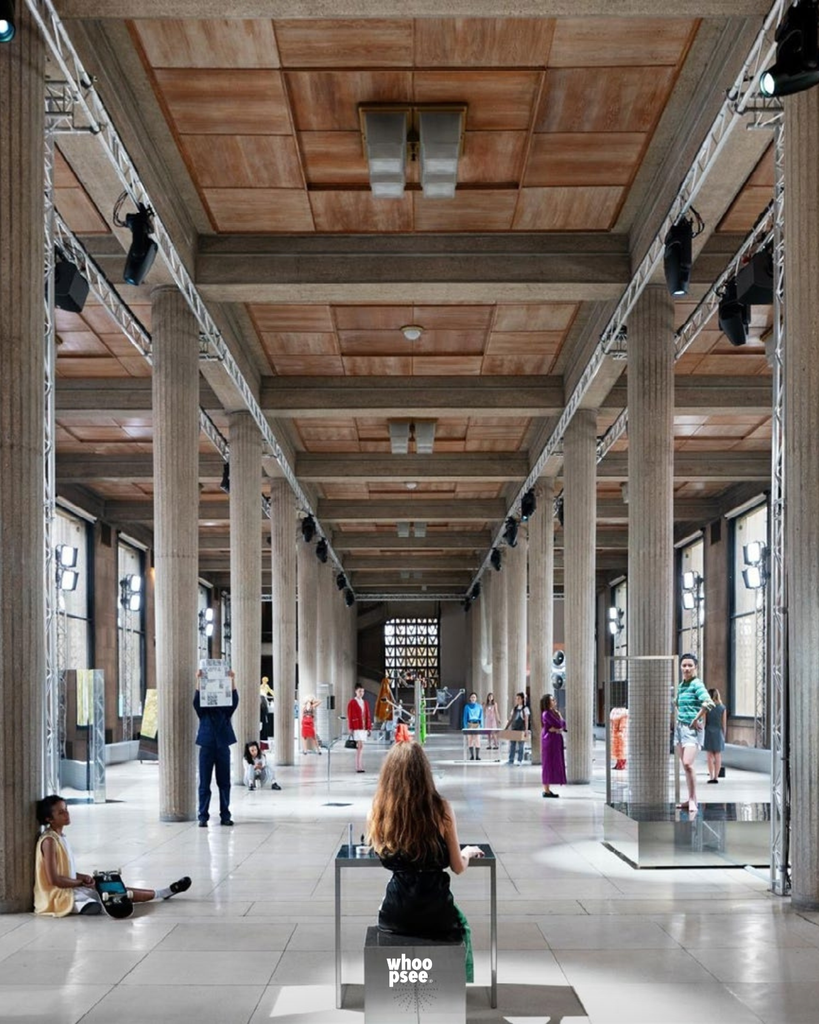
Speaking of time and temporality: have you ever thought of the set design as something that ages along with the show?
Yes, and in two different ways. The first is obvious and practical: scenes really do age—and almost always for the worse. The tour wears them down, the colors fade, the wood chips away, and at some point you end up with an object that’s no longer what you’d designed. The second sense is dramaturgical, and it interests me greatly: a set that transforms over the course of the evening without anyone changing it. Not visible set changes—which are a different kind of effect—but the idea that the same object, after an hour, has become something else because in the meantime you’ve discovered something that makes you interpret the space and its elements in a different, deeper way. And then there’s the case of *A Visual Diary*, which ages in the literal sense because the archive keeps growing and is constantly updated with new images. The show isn’t finished. It’s the only time one of my set designs matures rather than wears out.
Can you tell me about *A Visual Diary*? I was struck by the dual temporal process: moving backward coincided with an active construction of the present.
It came about by chance, like all things that end up lasting for years: from my encounter with the paintings of Patrick Angus, whom I didn’t know, and from the surprise of discovering that such a powerful body of work had remained virtually unseen. From there began a project that resembled an investigation more than a production: trips to the United States, research into materials, and above all, a search for people. Because those works weren’t in a museum—they were in someone’s home, preserved by relatives, friends, and former partners, with a devotion that is the true story behind the show. Then Larry Stanton and Darrel Ellis joined the project—three different life paths held together by the same era and by AIDS. The dual movement you mention is exactly what I felt while working on this. Every document I found sparked an action in the present—a phone call, a trip, a connection with a living person. The archive isn’t a storage facility; it’s a generator. And I believe this applies to any work based on the repertoire: when you stage Puccini, you’re doing the same thing, except the material is more famous and the witnesses have been dead for longer. The form came later, through subtraction: a table, two screens, a record player. I wrote the dramaturgy with Anna Siccardi; the videos are by Francesco Sileo; and it began as a commission from FOG — Triennale Milano. From there, it has continued to tour: after New York, Zurich, Basel, Prato, and Bologna, it will be at the Bourse de Commerce in Paris in November and at the Volksbühne in Berlin in January 2027. The form of the spoken narrative is particularly effective.
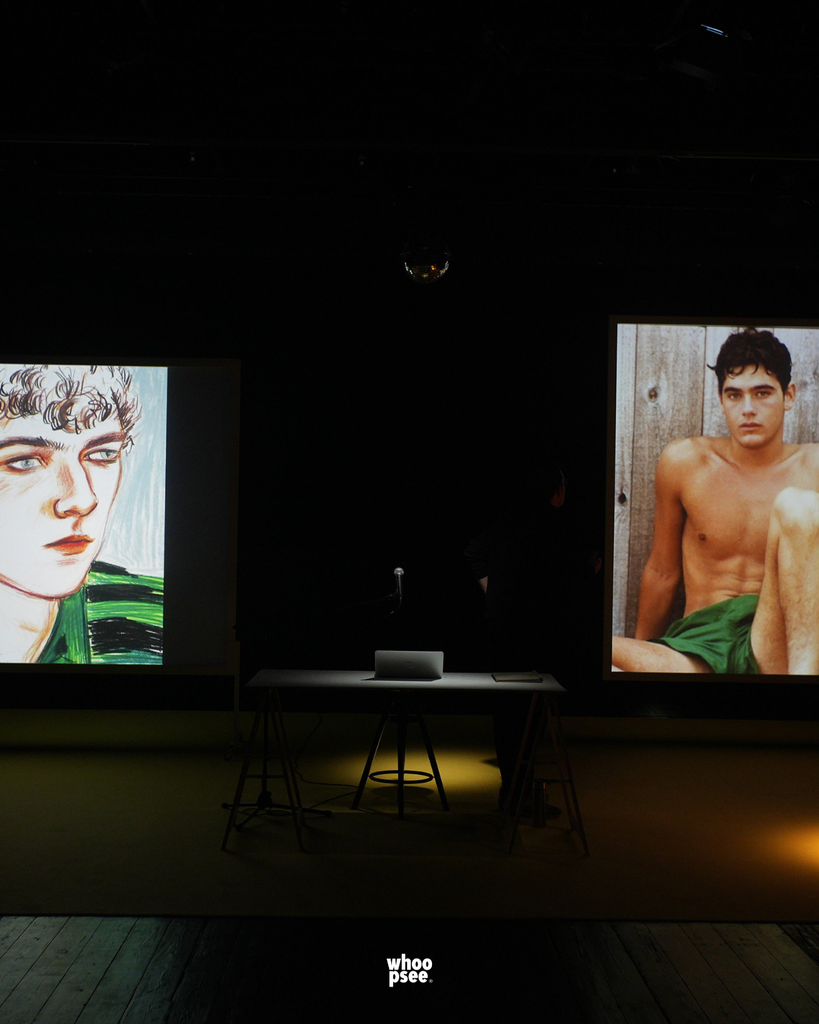
What was it like for you to experiment with the first-person perspective—placing your own experience, and even yourself physically, at the center—rather than working on a text written by someone else?
It’s very uncomfortable, and it took me a long time to accept it. Having the director on stage is usually a terrible idea, and for twenty years my job was the exact opposite: to create the conditions for others to take center stage, and to fade into the background. My training taught me to hide behind other people’s bodies—which, by the way, is very convenient. I arrived at this out of necessity, not desire: the material consisted of encounters, and I was the only witness to those encounters. By entrusting that story to an actor, I would have added a layer of fiction precisely where the opposite was needed: it would have become the interpretation of a man claiming to have known someone, and the word “really” would have evaporated. The first-person perspective, therefore, is not a confession; it is an assumption of responsibility: I am the one who chose these three artists; I am the one who rang those doorbells; and my perspective is biased. Declaring this is more honest than feigning the objectivity of a documentary. The technical challenge, on the other hand, was figuring out just how little to act. I’m a terrible actor, which turned out to be useful here: since I didn’t have a craft to showcase, I wasn’t tempted to put on a show.
“A Visual Diary” has breathed new life into works that had been overlooked, leading to international exhibitions, catalogs, and tangible forms. Did this inspire you to continue?
Yes, and it has become more of a method than a project. The process is always the same: you start with a passion—a work that moved you but isn’t talked about—and then you look for the person who’s kept the boxes. Almost always, there’s someone. And when that person realizes you’re not there to pull a fast one, they open their home to you. My research on Angus, Stanton, and Ellis isn’t finished—on the contrary, it continues to yield new material—and what emerges around the production—the publications, the exhibitions, the fact that institutions are now taking notice of them—matters just as much to me as the production itself. In fact, it has a longevity that theater lacks. I’m taking the same approach with other figures, even outside the theater: in the coming months, I’ll be presenting two documentaries. The first is *Annina Nosei—A Portrait*, dedicated to the Italian gallery owner who, from New York, discovered and supported artists destined to change contemporary art, Basquiat above all: an intimate portrait that moves between Rome, Manhattan, and New York State, where private life, memory, and great creative periods intertwine with intelligence, irony, and an unmistakable style. We presented the first cut at Palazzo Diedo in Venice during the Art Biennale. The second is dedicated to Lucia Di Luciano, one of the leading figures of Italian “programmed art,” who has spent sixty years engaged in rigorous artistic exploration while remaining on the margins of the official narrative: we will present it in late August at the St. Moritz Art Film Festival.

How did the San Carlo di Cremona project come about? And is this approach to emptiness an important factor in your practice?
It arose from the desire to work with Guglielmo Castelli and from an invitation to a very unique space: San Carlo is a deconsecrated church in Cremona, a private research space established by Lorenzo Spinelli in collaboration with Chiara Rusconi of Apalazzogallery. Visits are by appointment only and limited to a few people at a time—and this in itself is a dramaturgical choice: no continuous access, no chance encounters. Those who enter have made a conscious decision to do so. After all, a church is a theater that already has a script: a predetermined path, a nave that guides your steps, and a focal point at the far end toward which everything converges. We worked to ensure that the viewer walking down the nave enters the scene, rather than merely observing it. The dialogue with Guglielmo began with one of his texts, a nursery rhyme about suspension, about falling, and about the possibility that even error can find a form. From there came the central image: a large painting printed on an extremely long canvas, populated by suspended figures, which starts at the floor and soars toward the apse. It is an object that already contains a trajectory and a risk, and that overturns the function of the space without desecrating it: where the architecture once directed the gaze upward, there is now a limbo that promises a fall. His painting isn’t hanging; it’s enveloping the space.The performative element began as an activation: during the opening, I conducted a string trio from the Stauffer Academy and a choir of performers, the ITER Research Ensemble, with musical material ranging from the madrigal to John Cage. I wanted the music not to comment on the installation but to inhabit it, with bodies moving along the nave and the viewer forced to choose a vantage point. Once the performance is over, the space remains, and those who arrive afterward pass through it knowing that something happened there: to me, this seems the most honest definition of scenography. As for emptiness, it’s central to everything I do, and not for reasons of minimalism: it’s emptiness that allows us to see the body, to hear the sound, to make time last. It’s the starting point, and from that emptiness, we build, adding elements and meanings.
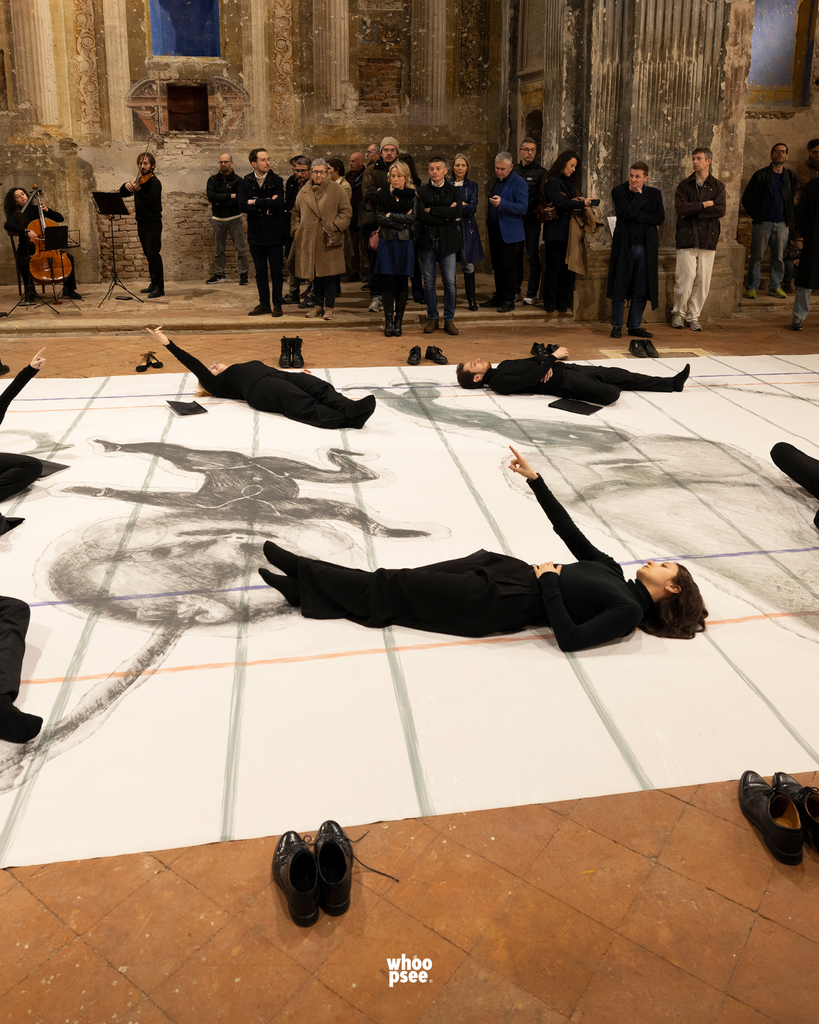
One last question, about repeating a performance. What is it like to perform the same show in ever-changing settings, in front of different audiences and in different cultures?
If you’re referring to *A Visual Diary*, it’s never the same show—and that’s not meant to be a compliment; it’s a technical description. The venue changes, the reverberation changes, the distance from the front row changes, and with that, the rhythm of the lines changes. Then the audience changes, and in a work like this, what changes most of all is the way the audience understands it. There are venues where that story—AIDS, the 1980s, invisibility—is a personal memory: at MaMa in New York, for example, there were people who had lived through those years, and certain silences became incredibly heavy while certain jokes didn’t elicit laughter. There are venues—often with very young audiences—where, on the other hand, it’s ancient history, almost archaeology, and so the show works as a revelation. The same script, two different productions.
That’s why I keep doing it myself, and it’s also why it’s exhausting: you can’t just put it on autopilot. If I go on autopilot one evening, it’s immediately obvious, and it doesn’t hold up. Which, all things considered, is good news: it means it’s still theater and not just a file.
[📷 Courtesy of FOG Triennale © Luca Del Pia, Courtesy of Miu Miu, Courtesy of the Haydn Foundation © Luca Del Pia, Courtesy of San Carlo Cremona © Andrea Rossetti]