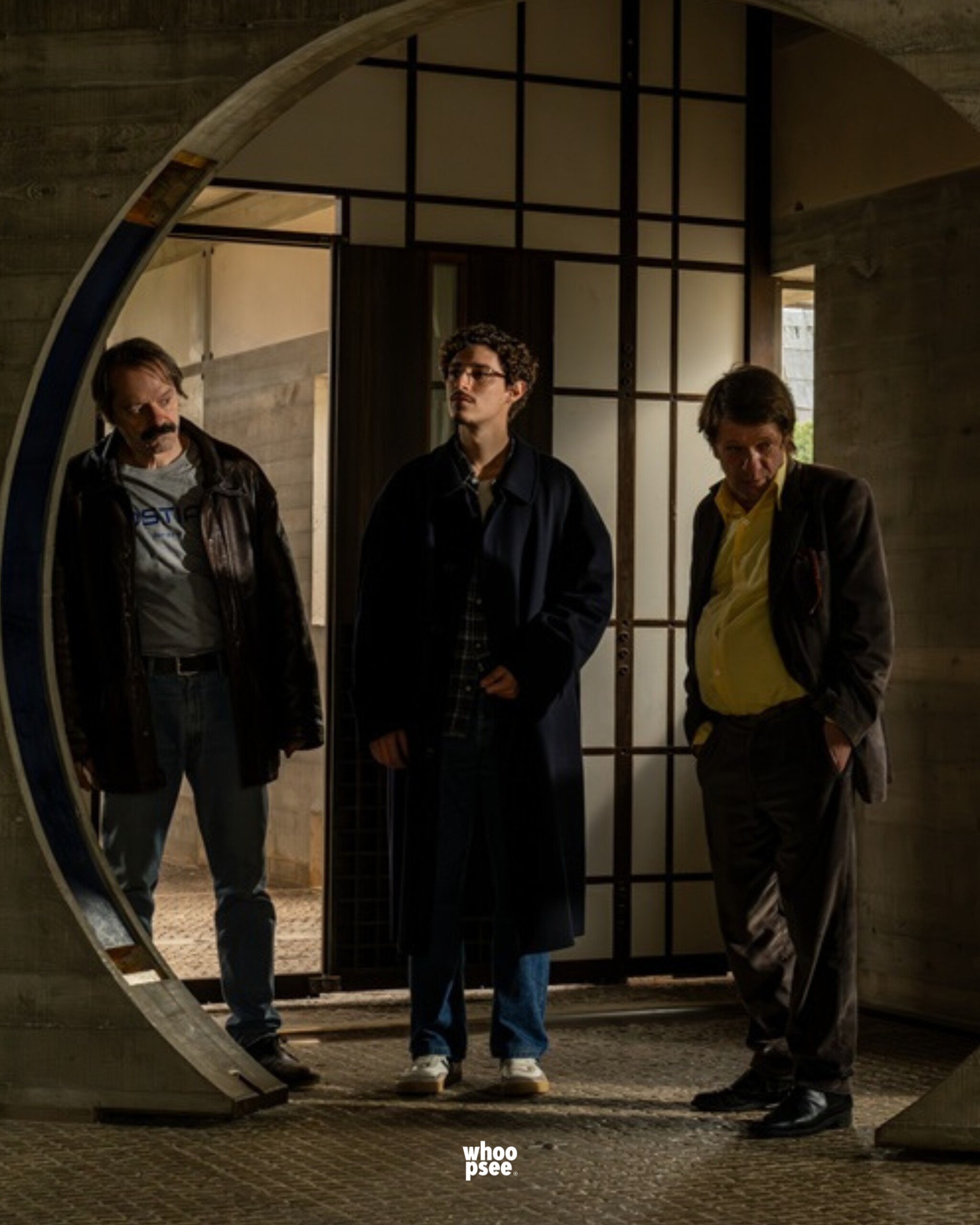
Cities on the Plains, released in 2025 and directed by Francesco Sossai, tells the story of the encounter between two roguish and melancholy figures-men who in the eyes of most appear to be on the fringes of society, estranged from the conventional trajectories of work, career and family-and a young Venetian student met during a night that seems never to end.
Carlobianchi and Doriano live chasing the “nightcap,” the last drink before returning home, as they await the arrival of their old friend Genio, who emigrated to Argentina after the 2008 crisis. During a long night drift they decide to set off for Venice, and along the way they meet Giulio, a shy architecture student secretly in love with a girl in his group. From that moment, almost without realizing it, the two men end up adopting him, dragging him into their universe of provincial roads, endless drinking, sudden detours and memories that resurface from the past.
The structure is that of a classic bildungsroman, in which the -or the, actually- protagonists, as well as the viewer himself, gradually gain a deeper awareness of themselves, their own frailties and desires. Giulio, at first impatient and distant, slowly allows himself to be crossed by this ramshackle humanity; but at the same time Carlobianchi and Doriano also reveal themselves little by little, showing under the ironic and alcoholic surface a tender melancholy, disarming in their directness.
The Venetian plain then becomes a suspended stage, a place of mystery and ghosts of the past, made up of decadent villas and forgotten nobility – memorable is the encounter with the owner of the villa who mistakes them for surveyors, an episode at once comic and subtly bitter – but also a space of fracture, where all the cracks of an Italy crushed by the economic crisis and the dissolution of its communities surface. Closed factories, abandoned historic bars, villages struggling to withstand the ravages of so-called progress: everything in the film seems to speak of a world that is slowly being consumed.
And Carlobianchi and Doriano fully belong to this human landscape, ramshackle heroes resisting contemporary conventions. At one time, together with Genio, they worked in an eyeglass factory, going so far as to build up a lucrative underground trade by selling production scraps. Then the collapse: Genie flees to Argentina, the others dissipate the money, and remain trapped in a province that seems to live out of time. Their constant journeys, the last drinks consumed one after the other, the roads traveled without a real destination, then take on the sense of a perpetual flight, but also of a nostalgic search for youth, for a remote time when everything still seemed possible.
Emblematic is precisely the return of Genio, who emigrated far away to save himself and is finally forced to discover that his hidden treasure, buried years earlier in the Venetian countryside, has been lost under an unfinished construction site. It is a most powerful image: the past erased by failure, dreams submerged by a modernity that has itself remained unfinished.
Yet the film guards a surprisingly bright look at its characters. Carlobianchi and Doriano are surrendered men, this is true: they do not really fight against reality, they seek no redemption. But they possess a very rare quality, perhaps the only one that really matters: the ability to dwell on beauty. A shared ice cream, an impromptu lunch, a last drink together, the loving enthusiasm of a young boy who still feels the world wide open before him: these are the things that keep pushing them toward a delicate contentment. And it is in this dogged attention to human detail that they manage to escape the bleakness that surrounds them.
The province, then, stops being just a marginal geographical place and becomes the whole of Italy. Because Italy is not only made of big cities, big companies, big centers; it is made above all of margins, of villages, of minimal and silent humanity. Whether in the Veneto, Calabria or Molise, the province remains the place of the most fragile and precisely for this reason the most authentic humanity. And it is a humanity that deserves to be told. Just as life itself deserves to be told, in its fragile obstinacy, made up of small things, and for this reason immense.
It is perhaps this that the film suggests: that even within a reality marked by defeat and disillusionment, the meaning of our existence lies in the little things, in the truth of encounters, in the gratitude for affection found and for a youth lived to the fullest, in the sweet, trust-filled gaze that guards those who have “failed,” looking to a young man who wants to find the courage to begin.
[📷 vivofilm.co.uk]