The story of the Louis Vuitton Cup is, after all, the story of how sailing stopped being just a sport for a privileged few and turned into a global, technological and cultural spectacle. To really understand what this competition represents today, one has to go back a long way, even to 1851, when the American yacht America crossed the Atlantic to challenge the British in the waters off the Isle of Wight. She won against the British fleet and took home a silver cup destined to become the oldest sports trophy in the world: the America’s Cup. From that moment a tradition was born of exclusive yacht clubs, tycoons, aristocrats and challenges that seemed to belong more to a private club than to modern sport.
For more than a century, the America’s Cup remained an almost mythological, closed competition that was difficult to follow and even more difficult to understand. The boats were huge floating laboratories, but everything took place away from the general public. Then came the 1980s and the world changed quickly. Television changed, sports marketing changed, international luxury changed. And that’s where Louis Vuitton came in. The French fashion house realized before anyone else that that ancient, sophisticated, and glamorous competition could become something huge. Thus in 1983 the Louis Vuitton Cup was born, the tournament designed to select the official challenger to the America’s Cup. It seemed like an organizational detail, but in reality it was a total revolution.
That year, by the way, something historic also happened at sea: the Australians of Australia II broke the 132-year American dominance. The America’s Cup suddenly stopped looking invincible and became a worldwide battle. Louis Vuitton sensed that the future lay there: turning the qualifiers into a major international event, with its own identity, sponsors, storytelling, and a sporting tension even greater than the final itself.
From that time, sailing slowly began to change its image. Teams became companies. Designers came from aeronautics and Formula 1. Budgets exploded. Technology entered every detail: composite materials, simulations, advanced meteorology, predictive software. And in the meantime, a new, very elegant and very powerful imaginary was born, in which Louis Vuitton managed to fuse luxury and sport in an almost perfect way. It was no longer just a regatta: it had become a symbol of international prestige.
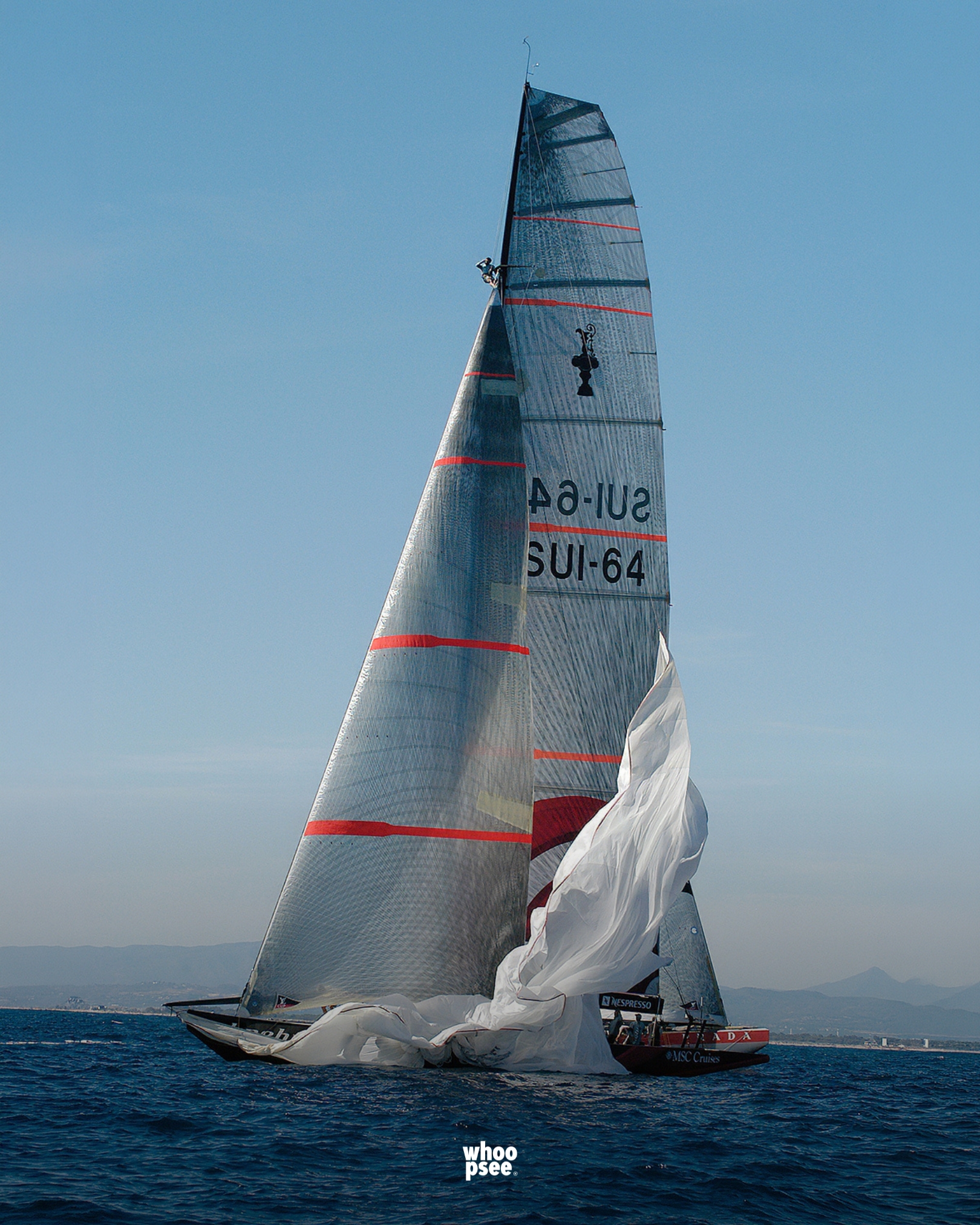
In the 1990s, the Louis Vuitton Cup finally exploded into global sports culture. Legendary personalities arrived, boats became icons. And then came Italy. For Italians, the Louis Vuitton Cup has a special meaning because it coincides with the birth of Luna Rossa. When Patrizio Bertelli and Prada decided to enter the America’s Cup, many thought it was just an image operation. Instead, it was the beginning of something huge. Luna Rossa managed to create an emotional bond that no Italian boat had ever had before. In 2000, in Auckland, the Italian team won the Louis Vuitton Cup by beating AmericaOne and winning the right to challenge Team New Zealand for the America’s Cup. For weeks, Italy stood in front of the television. The races aired at dawn, but millions still followed every start, every tack, every duel. Luna Rossa immediately became much more than a sailing team: it was Italian design, elegance, technical obsession, competitive spirit. Since then, the bond between the Louis Vuitton Cup and the Italian public has never really broken, in fact it has grown over the years.
Meanwhile, the America’s Cup continued to transform. The old boats gave way to increasingly extreme craft. First came the giant catamarans, then foiling, that is, the ability of boats to literally “fly” on the water thanks to foils that lift the hull, reducing friction. With the AC75s, the flying monohulls used today, the Louis Vuitton Cup has become something between Formula 1, an aerospace simulator, and a traditional regatta. Crews are smaller but infinitely more specialized. Today you need pilots, flight controllers, data analysts, aerodynamics experts. In this, Barcelona 2024 was another decisive turning point: the Catalan event showed how the Louis Vuitton Cup is now a perfect global product for the digital age, including spectacular racing, huge audiences, social content everywhere, villages open to fans, new international audiences. Sailing has officially entered the language of contemporary entertainment.
And this is where the most important news of all enters: Naples 2027. For the first time in history, the America’s Cup and the Louis Vuitton Cup will come to Italy. A choice that has enormous symbolic value. The Gulf of Naples will become the world center of sailing. Images of the regattas with Vesuvius in the background have already fired the imagination of the entire sporting world. For Luna Rossa it could be a once-in-a-lifetime opportunity: racing at home, in front of the Italian public, at a time when the team appears more competitive and mature than ever.
But Naples 2027 will not just be a regatta. It will be a gigantic cultural, economic and media operation. There is talk of huge investment, international tourism, infrastructure, urban transformation and unprecedented global visibility. Louis Vuitton has also confirmed its central role in the project, a sign of how strong the link between the French maison and the America’s Cup still is after more than 40 years.
[ 📷 IPA]