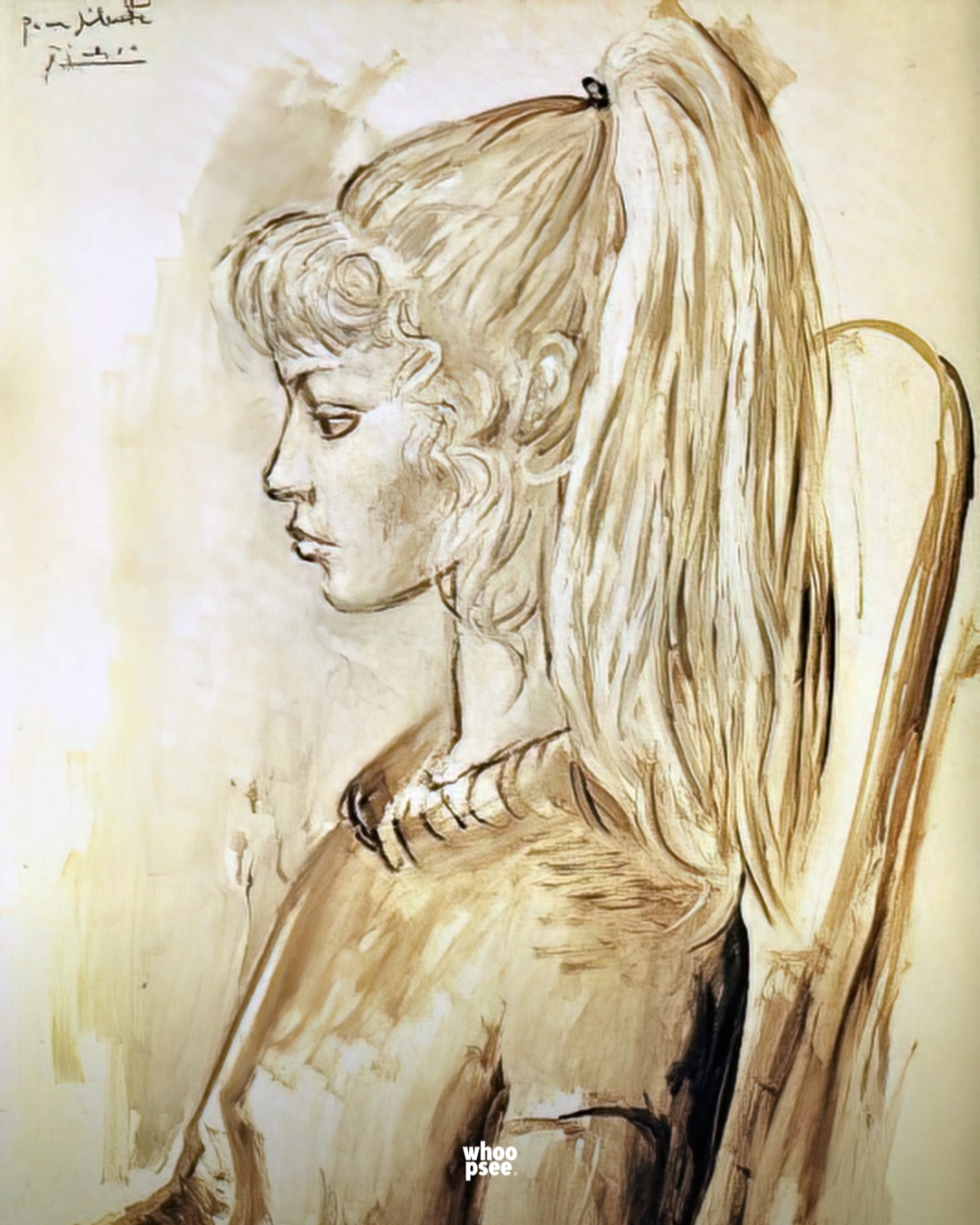
Sylvette David was born in Paris in 1934 to a family of British origin. She spent her childhood between France and England and, in the early 1950s, moved to Vallauris on the French Riviera with her fiancé Toby Jellinek, a young furniture designer. She was nineteen years old when, in 1954, she met Pablo Picasso. The encounter happened almost by chance: Picasso purchased two chairs designed by Jellinek and invited the couple to his studio; from that moment on, an intense artistic partnership began.
At the time, Picasso was seventy-two years old and was going through a period of profound personal change. The previous year had seen the end of his long and controversial relationship with Françoise Gilot, while Jacqueline Roque—who would later become his second wife—was entering his life. Against this backdrop, Sylvette became his new muse. One could say that she embodied the younger, more childlike, and less sensual counterpart to the female figures Picasso had portrayed up to that point. Her shyness, tinged with doubt and uncertainty about life, reflected the still unspoiled gaze of someone looking toward the future with freshness and innocence. Over the course of just three months, Picasso portrayed her tirelessly, almost obsessed with her profile, her long neck, and her unmistakable ponytail. He created about sixty works inspired by her—including paintings, drawings, and sculptures—transforming those distinctive features into an essential language composed of lines, shapes, and silhouettes. The “Sylvette” series is now considered one of the most famous cycles of his work from the 1950s.
After the exhibition of her works, Sylvette suddenly became a familiar face. She appeared in the magazines of the time, and it is said that even Brigitte Bardot was inspired by her hairstyle and her way of dressing. Despite her fame, her relationship with Picasso remained calm and free of romantic entanglements: the photo sessions took place in an atmosphere of tranquility and mutual respect. As compensation for her role as muse and model, Picasso offered her the chance to choose one of the works he had created. Sylvette opted for a black-and-white profile portrait, explaining that it was the one in which she recognized herself most, “almost as if it were a photograph.”
That encounter and the long sessions with the artist left a deep impression on the young woman. Years later, she recounted that Picasso had instilled in her confidence in her own abilities and had given her a glimpse of the possibility that she, too, might one day become an artist. It wasn’t until she was forty-five—by then a mother—that she began painting regularly, adopting the artist name Lydia Corbett. Sylvie later recounted on several occasions that she had distilled into her own artistic practice everything she had unconsciously absorbed during that youthful experience alongside the master. In her memories, Picasso remains the figure of a kind, generous man who was able to encourage the talent of others.
This is a rather unusual account, especially when compared to those of many other women in his life, who instead described him as an authoritarian, possessive, and often despotic artist. Picasso’s image has now been deeply shaped by these countless accounts, and perhaps for this very reason, Sylvette’s story represents a valuable voice in the complex mosaic of relationships that shaped Picasso’s life.
[📷 IPA]