A memory, a feeling that begins in the eyes and then settles somewhere between the chest and the memory. Cinema isn’t just film, actors, or stories: it’s an emotional archive that builds up over time, a place where we grow without even realizing it. It’s the way we learn to look at the world through a lens that didn’t belong to us before and that we suddenly feel is our own. Every film is a threshold: you enter as who you are and emerge slightly different. And in between lies a suspended space where images pass through us, blend with personal memories, and change the way we interpret what we experience afterward. Watching a film also means accepting to be temporarily transformed by someone else’s perspective, and then taking away a fragment of it that will continue to work within us, silently. In the summer, cinema moves out of traditional theaters to the town squares, among the people, under the open sky. And outdoor film festivals are growing more and more popular—not because they’re a seasonal trend, but because they manage to restore a broader sense of what cinema is at its core: a shared, physical, collective experience.
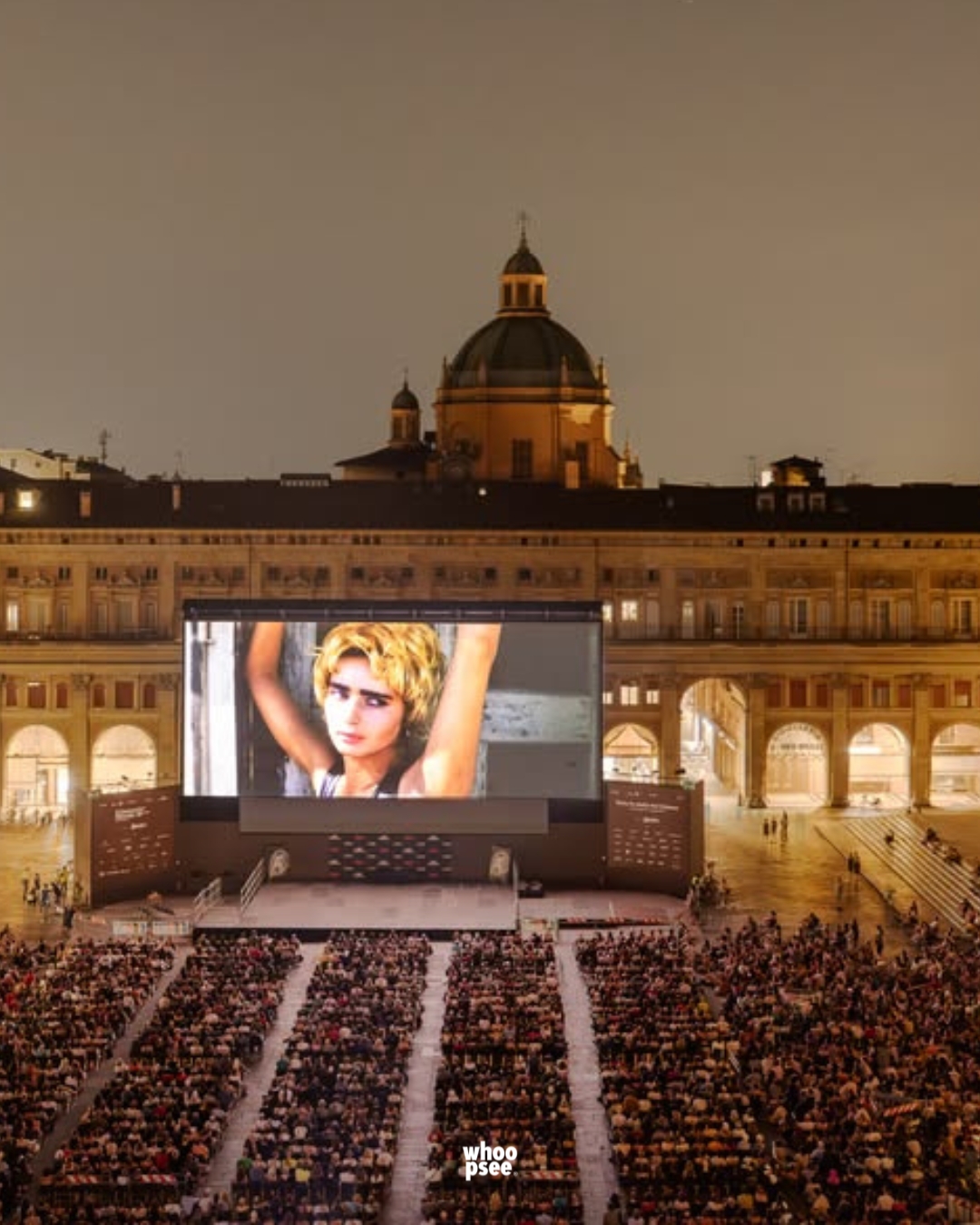
“Open-air cinema is so popular because it embodies, in its purest form, the very essence of cinema itself: collective viewing,” we’re told by the Cineteca di Bologna, which produces two major summer events: the Il Cinema Ritrovato festival (which has been held for 40 years in many of the city’s theaters and in the evenings in Piazza Maggiore) and the Sotto le stelle del cinema series (which has been held for 30 years exclusively in the evenings in Piazza Maggiore). “Our mantra is: cinema is a collective experience—we laugh and cry together. The emotions evoked by cinema cannot be experienced alone; they must be shared among all viewers.”
This cinema has a long history: “The cultural need underlying these events is the same one that led to the founding of the Cineteca back in 1962: to make cinema an art form on par with others. This may seem obvious today, precisely because so much has been done over the past 60 years to promote this art form and its heritage,” they tell us. “We strive to do this in our theaters every day, and in Piazza Maggiore this experience reaches its pinnacle: a unique experience capable of bringing together people of all ages and from every corner of the world in the face of the magic of the screen. In all of this, a city like Bologna—so open and culturally vibrant—is the key element. Sometimes in Piazza Maggiore we screen silent films; the films are always shown in their original language, and often they are rare—even extremely rare—titles. Well, the audience’s curiosity is always at its peak. So, of course, viewers are drawn to the films, the atmosphere, and the sense of community (all factors that are inseparable from one another).”
A shared vision that we also find in the words of the Piccolo America Foundation in Rome, which launched one of the most beloved events: “The desire to be together, to share something in person, to feel part of something has never gone away: it had simply been left without a place to express itself—perhaps we were forgetting it. Open-air cinema brings it back: free, physical, among others. When you host a great evening in a square, featuring a masterpiece from the past, and three thousand people sit on the ground, you realize that this need was already there: it was just waiting for someone to take it seriously. Or perhaps to remind us of that desire?”
Today, the Piccolo America Foundation is one of Italy’s most beloved cultural institutions, but it all began almost by chance—with a group of students, a movie theater slated for demolition, and a desire to give the city back its gathering places. “We were high school and college students. With the Gelmini reform, schools had started closing in the afternoons—that was the first effect of the education cuts. In 2012, we knew almost nothing about cinema: the Cinema America was about to be demolished, so we occupied it alongside the residents to prevent the loss of yet another piece of our city’s history and social life. From there, almost by chance, the rest came about: San Cosimato, 180 meters away—an empty square waiting to be filled. The need we identified was for a city to be revitalized: to nurture relationships, to start meeting again. Just like at the little wall near home in the outlying neighborhoods where we come from.”
And perhaps this is precisely where open-air cinema reveals its deepest truth: it is not a “summer” version of traditional cinema, but a return to its most essential origin. A space where one’s gaze is never truly individual, because it is constantly intertwined with that of others. Laughter spreads from one end of the square to the other, silence becomes shared, and emotion multiplies. A place where you don’t just watch a story, but learn, once again, to see yourself through others. “Cinema is a collectively empathetic act; I laugh because the person next to me laughs, I feel sorrow because the person near me is crying. Movies only become cinema in movie theaters. But this isn’t just having an aperitif with a movie playing in the background—it means being part of a community that dreams,” concludes the Piccolo America Foundation.
[📸 Courtesy of Fondazione Piccolo America; Instagram: cinetecabologna / © Lorenzo Burlando 📹 TikTok 20angeline04, caro_vida, mollycooperx, ilcascinetto, eugeniaabarbieri]