Madomorpho is a Berlin-based brand born in Amsterdam during the formative years of its two founders, Emma Postma and Saga Peterson. A shared vision based on an idea of a free and sensual woman and an experimental and instinctive attitude toward fashion design are the reasons that led them to join forces to shape eclectic, provocative, cleverly “dismembered” garments. Palettes and references from yesteryear merge with an ultra-contemporary aesthetic that goes beyond categorization: each piece is designed to be worn naturally, adapting to different bodies thanks to laces and strings with a nostalgic touch, designed for a woman who goes out, lives, has fun, and populates the night with a glittering presence. Secondhand and quality raw materials are the starting point, then go on to deconstruct pre-existing structures and give them new light, giving garments or fabrics from the past new forms and unexpected functions. The transformative potential of the collections lies in daring juxtapositions of materials, patterns, colors, in clothes that want to rethink the way of dressing, infusing everyday life with a sense of theatrical lightness, celebration, and above all freedom.
I had the pleasure of having a chat with Emma and Saga, who told me about the origins of Madomorpho and their vision for fashion.
Let’s start from the beginning: how was Madomorpho born?
“We met while studying in Amsterdam, at AMFI (Amsterdam Fashion Institute),” Saga says. “We were friends, then we found each other in Berlin: I had moved away, Emma came for the summer for an internship at Lou de Betoly and never left. It was the Covid period, we had time, a studio with sewing machines, and we spent our days making clothes, experimenting with what we found, drinking wine and spending hours in the studio, having fun inventing outfits and party looks.” There was no business plan, no immediate idea of building a structured brand. “It all started very innocently. We also opened a Depop, we were selling vintage, we were upcycling. It was a way to express ourselves and together to see if what we were doing could be of value to others.” The transition from spontaneous project to conscious brand was gradual. “In the beginning we wanted to keep our individuality very strong: ‘this is your part, this is mine.’ Over time, the boundaries dissolved. Today we do almost everything together.”

How does your creative dialogue work?
“There are natural inclinations: Saga for example is more into drawing and the more craft aspect, I love construction, tailoring, technical work. But there are no rigid divisions. We are always in each other’s work. Even an e-mail rarely leaves without a confrontation,” Emma says. This osmosis is also reflected in brand management. “For a long time we worked three days a week on Madomorpho and the rest we would devote to side hustle to support ourselves. Only in the last year did we start to feel really independent.” A key moment was meeting Robin Burggraaf, a consultant and mutual friend: “He helped give us structure. For years we were enthusiastic but chaotic. Now we work with an annual plan, with deadlines. It’s critical.”
Your name is evocative: what is the origin of “Madomorpho”?
“This is one of the questions we get asked most often. The truth is that it doesn’t have an unambiguous meaning, and we like it that way. It’s a sound we built together, combining words that somehow represent us.” “Morpho,” inevitably, invokes transformation. “We like that it can suggest metamorphosis, continuous movement. It doesn’t belong to a specific language or place-it can be pronounced anywhere.” The visual identity is also part of the narrative: “The font was created by the Saga boy, inspired by the aesthetic traits typical of Art Deco and Art Nouveau. It is eccentric, sinuous, theatrical, almost cinematic.”
Where does the imagery of your collections come from? And coming into the present, what can you tell me about the new 2026 collection?
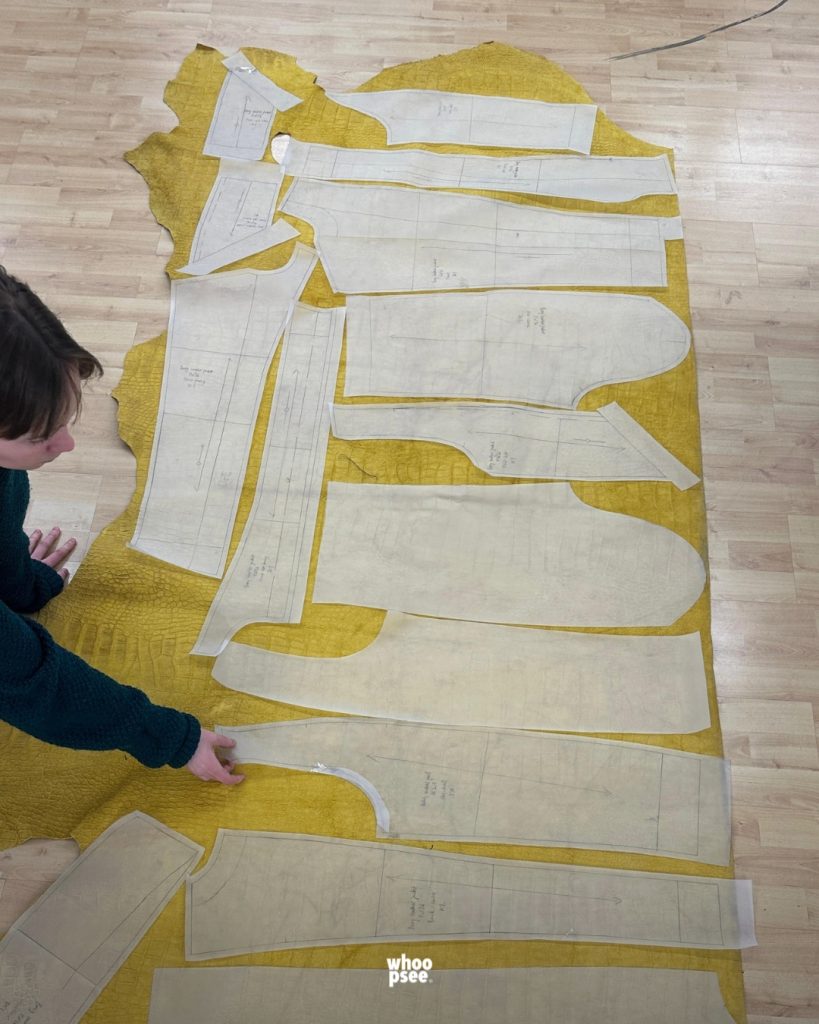
“We often start with materials. We find deadstock fabrics, feathers, Mongolian furs, colored leather, sometimes from old theater costumes, and they tell us a story.” The process is almost stage-like: tables full of raw materials, conversations, experimentation and suggestions. “We think of an era, a place, characters. A nightclub, a circus, a cruise ship. We create imaginary women who inhabit those worlds and translate them into the contemporary.” For the newly presented collection, inspiration moves between Marlene Dietrich’s 1920s Berlin and the exuberant aesthetics of the 1980s. “We are fascinated by the idea of cabaret, but also the after party: the performers who, after the show is over, get together, take off their shoes, lift their legs up on a table, drink, laugh. There is a sense of excess, of freedom, of carefreeness.” The collection, consisting of about 30 looks, is titled The After Show. “It is the biggest one we have done so far. Lots of handwork, glamour, feathers, color.”
The past is a constant reference in your pieces. Do you feel like a “vintage” brand?
“We are very inspired by history and vintage, but we don’t want to be perceived as nostalgic. The starting point may be historical, but we always rework it in a contemporary way: in materials, in design, in combinations, and especially in attitude.” Inspiration can come as much from a movie as from a reality show. “We’re not afraid to mix high and low.”

Let’s talk about materials and sustainability.
“Most of our fabrics are deadstock or second hand. It’s partly an ethical choice, partly an economic one, but mostly creative. In Berlin it’s hard to find luxury materials at affordable prices.” Emma and Saga often buy from deadstock specialty stores or theatrical costume sales. “Sometimes we buy a garment in its entirety and dismember it completely. It’s not upcycling in the most visible sense of the word: we don’t want people to recognize that it was a pant turned top, for example. We are interested in reusing the material, the seams, the details. “They don’t like greenwashing or excessive rhetoric about sustainability. “It matters to us to use natural fibers, like silk, or leather, and to create garments that are meant to last. Durability is central for us, creating something that will last. Even our shoes, which are ethically produced in Europe from certified leathers, have leather soles-they are very complex to make, they need to be resole, cared for. Ours is a long-term relationship with the object.”

Are you working on made-to-order or ready-to-wear today?
“In the beginning we were very made-to-order oriented, especially for more complex pieces. Now we are introducing more and more ready-to-wear: knitwear, mesh pieces, accessories. We want to find a balance that allows us to focus energy on the right things.” The dream? “Getting into stores, having retailers. Our live garments have a different presence. They are very detailed, requiring time and attention. Seeing them worn, touching them, it changes everything.” And then, of course, the runway. “We’d like to get to a runway show in 2027, maybe in Paris. But let’s see, one thing at a time. Better to wait and do something really good than to rush it.”
What does the context of Berlin offer you as a creative venue?
“Berlin is an accessible city, allowing us to create at a faster pace. Living costs are low, getting around is easy, and we are able to source materials and raw materials consistently at affordable prices. Let’s say that the problem lies perhaps in the kind of aesthetics ingrained in this city rather than in the practicality of the day-to-day. Sometimes we feel that our language is not perfectly aligned with the dominant aesthetic here, which is darker, more masculine than our creations.”
The goal is to get into the right circuits, perhaps through Paris showrooms. “We see a lot of people moving to Paris and growing. It’s a question of context but also of mentality. We will see over time if our future is there.”

One last question, which is perhaps at the root of it all: what kind of woman do you imagine when you think of the woman who wears Madomorpho? “We don’t think of a specific person, but an attitude. A strong, confident, fun-loving woman. Perhaps, indeed almost certainly, with a drink in her hand.” The imagery goes back to the nocturnal Berlin of Marlene Dietrich and her out-of-the-box romances, but it also projects into the present. “We are inspired by women who are a bit more mature, in their 30s or beyond. People often think of ours as a very young brand. In reality, our playfulness is not adolescent: it is freedom sought, wanted and finally conquered.” A self-aware femininity, capable of being excessive without asking permission. “When you are more confident you can allow yourself to be extra, theatrical, even a little goofy, while still managing to remain incredibly chic.”
Trawling through the various preparations and shoots of the new collection, amidst reclaimed feathers and Italian silk, the impression is that their “after show” is only the beginning of the first act of what may become a wonderful opera.
[📷 Emilio Tamez ; Courtesy of Madomorpho]