Louis Vuitton’s positioning transcends the dimension of the single category to configure itself as an all-round cultural project, in which aesthetic expression is understood as an accomplished art form. This vision finds clear confirmation in my visit to the store on Via Montenapoleone: I chose to dwell on the artistic presences and curatorial interventions, which are often less observed by those who are mainly attracted to fashion collections, but revealing of a precise and conscious orientation. Indeed, it is in these details that the maison’s ambition to inhabit a cultural space, as well as a commercial one, is most clearly manifested.

The renovated space on Milan’s Via Montenapoleone finds a home in a building built in 1835 to a design by Ferdinando Albertolli, a fine example of late Milanese neoclassicism, with a facade punctuated by Ionic columns and tympanums. After three years of conservation work, it reopened its doors last March, preserving as much as possible the original layout and transforming itself into a container in which fashion, gastronomy, design and art coexist in a continuous dialogue, as integral parts of a single aesthetic and cultural narrative.
The building has been restored while maintaining the typology of the Milanese palazzo, with internal galleries and stucco arches restored to their integrity. The historic entrance, an arched door framed by decorations in warm, restrained tones, leads to a courtyard that is now high, enlivened by cascades of greenery cascading down from the galleries. A glass skylight lets sunlight filter through, enveloping the space in diffuse, natural luminosity. The project, signed by Peter Marino, who has been curating the maison’s boutiques around the world for years, favors fine materials linked to the territory: local carpentry, stones worked in Lombard workshops, up to fifteen varieties of minerals, including Giallo di Siena, from Tuscany and historically widespread precisely in Lombardy. The marble staircases evoke the elegance of Villa Necchi Campiglio, designed by Piero Portaluppi, while the suspended structure of the steps and the semi-arc leading to the keystone recall Palazzo Bugatti Valsecchi. The shop windows pay homage to the city with a meticulous reproduction of Milan Cathedral, restored in the details of the Gothic pinnacles. On the second floor, the footwear area features ceilings inspired by Milan’s androni, with stucco and plaster designs; the room dedicated to women’s ready-to-wear recalls Casa Corbellini-Wassermann, another Portaluppi masterpiece. The whole blends Milanese architectural references with the maison’s identity elements, such as the Damier motif, in a coherent balance between memory and contemporary code.
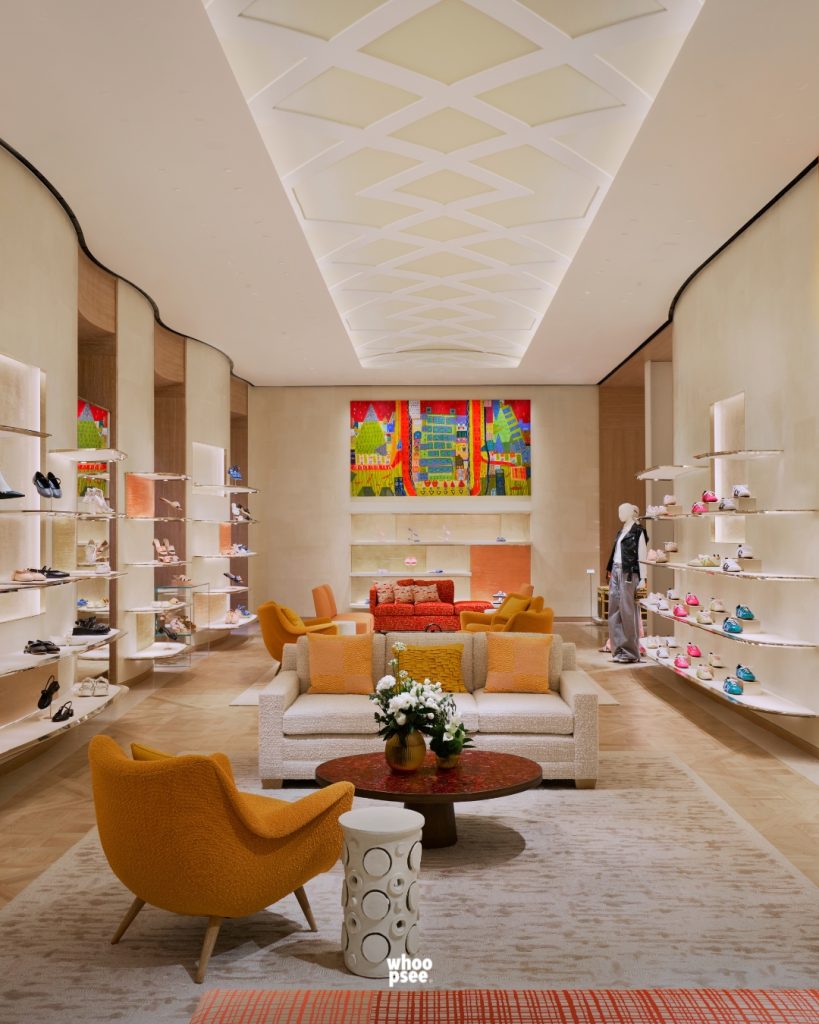
The artistic selection reinforces this dialectic between local and global. Mimmo Paladino, among the protagonists of the Transavanguardia theorized by Achille Bonito Oliva, dialogues with Carla Accardi, a central figure in post-World War II Italian art. Alongside them appear Gianfranco Baruchello and Alfonso Clerici, with works by the latter created ad hoc for the maison. The international dimension emerges with Peter Halley and Iranian Farhad Moshiri, whose embroidered and bead-embellished canvases dress the rooms of the store. The curatorship thus returns a layered narrative: Italian masters, protagonists of the global scene and research artists coexist in a coherent plot, which makes deep care its trademark.
Design also contributes to this narrative. The Objets Nomades collection features furniture conceived as mobile treasure chests of beauty, signed by designers such as Patricia Urquiola, Cristian Mohaded, and Damien Langlois-Meurinne. Alongside contemporary creations are carefully restored historical pieces of Italian design: Ico Parisi, Gio Ponti, Osvaldo Borsani and Angelo Mangiarotti, designers dear to the city of Milan.

Finally, the space dedicated to gastronomy: here, too, the artistic imprinting is strong and can be seen in the details. Loosely inspired by a jardin d’hiver that seems to come straight out of a Cecil Beaton photograph, its floor is a true work of art, made with stones in color gradations from white to black, mimicking a drawing by Martin Kline. The greenery that triumphs throughout the space is curated by Milanese landscape designer Marco Bay, and hand-painted fabrics alternate with terracotta vases made in Lombard ateliers.
The overall result of the space is thus a majestic interweaving of references and craftsmanship, an environment in which the Milanese manufacturing heritage and the international vision of the maison meet and dialogue with measure. This new Louis Vuitton store thus becomes a cultural as well as a commercial space: a place where local identity and global breath find a conscious synthesis, a symbol of a brand that wants to go deeper and engage visitors in a 360-degree aesthetic and artistic experience.
[📷 Courtesy of Louis Vuitton]