There are brands that build their identity through an image, and others that build it through a precise vision of reality—one that is real because it is lived. Humanoid belongs to the second category: a consequence of a way of being, a way of looking at the world, of thinking about the body and clothing.
In an increasingly fast-paced fashion industry, where novelty often becomes a value in and of itself and where image risks taking precedence over substance, Humanoid continues to champion a belief that goes against the grain: behind every garment are people. People who imagine it, create it, and wear it. People whose lives don’t stop when they walk into the office—people with loved ones, responsibilities, passions, and vulnerabilities that are inevitably part of how they work as well. Perhaps this is precisely the most contemporary form of punk that the brand embodies today: not an aesthetic or formal provocation, but the radical choice to put the human being back at the center.

The story of Humanoid begins in 1981 in Arnhem, the Netherlands, when Sandra Harmsen and Hans Boelens founded the brand, driven by a genuine passion for fashion and a creative spirit that was very much in keeping with the independent ethos of those years. Humanoid came about almost by chance, with Sandra sewing with fabrics she found at the market, and her one-of-a-kind pieces—displayed at market stalls and small local shops—caught the attention of major players overseas. Humanoid also emerged in a context where fashion interacted with art, music, and underground culture—an environment more focused on experimentation than on crafting a glossy image. That original freedom remains imprinted in the brand’s DNA and continues to permeate it over time. Humanoid has grown over the years, developing a recognizable aesthetic—one made up of essential yet never anonymous pieces, carefully selected materials, and a natural, unforced femininity. A vision that, over time, has become a true identity.
It is precisely this deep connection to that identity that led Daan Berkhoff and Charlotte Verdegaal to take up the torch. Even before becoming the new owners, both had worked at Humanoid: they knew the brand from the inside, understood its sensibility, its rhythm, and its way of thinking. When the opportunity to take it over arose, they decided to take a step that required a great deal of courage and, as they themselves say, even a certain amount of recklessness. Because taking over a company with a history spanning over forty years means shouldering an enormous responsibility. It means safeguarding something that belongs to many people even more than it does to oneself. But it also means believing so strongly in a vision that one is willing to keep shaping it, refining it, and steering it forward.

After years in Arnhem, the place that had served as Humanoid’s creative home began to change. The ecosystem that had supported the brand’s growth was weakening: many of the creative businesses with which they had shared a journey were disappearing, and the time had come to ask where the company’s future might lie. The first answer seemed to be Amsterdam. The city of fashion and international creativity—seemingly the most natural fit for a brand like Humanoid. But a practical problem soon emerges: Amsterdam is extremely expensive, and Humanoid needs space. This is because their way of working doesn’t involve a clear separation between conception and production. Design, production, and the brand’s day-to-day life must coexist. Their search therefore led them to Utrecht. In a neighborhood of artists, young entrepreneurs, artisans, and emerging businesses, Humanoid finds a new home and fertile ground for fresh inspiration. The same energy that had led Sandra and Hans to create an independent brand in the 1980s returns in the next generation: that willingness to follow a conviction even when the path isn’t fully mapped out. The new space in Utrecht preserves Humanoid’s legacy while simultaneously expanding it: an environment where design, production, sustainable materials, and collaboration coexist, where the brand can exist as a creative community even before it exists as a company. And it is precisely the concept of community that is one of the key words for understanding Humanoid.
Daan and Charlotte describe a corporate culture rooted in transparency. This transparency, however, is not merely a corporate principle—it is a way of acknowledging the complexity of people. In their day-to-day experience, colleagues know a great deal about one another, even in their private lives. If an unexpected phone call comes in, or if a family situation requires attention, the team’s response isn’t pressure, but support. It’s a simple image—down-to-earth in its truth—but it conveys a clear philosophy: before we are workers, we are people. Amid cigarettes and coffee stains, presentations, brainstorming sessions, and discussions, the brand grows, nurturing and being nurtured by the people who make up its various, very human nuances. And it is this very perspective that finds its way into the collections. Humanoid clothes aren’t designed for some ideal, distant image, but to accompany real life. They’re designed for a body that moves, for a person who works, meets friends, travels, loves, and changes plans throughout the day. Simplicity, in their case, never means a lack of character. Charlotte uses a Dutch expression to describe Humanoid’s garments: “net iets anders”—something “slightly different.” A shirt with a slightly different seam, pants with an off-center drawstring, an unexpected stitch—a subtle variation that makes a garment recognizable without needing to state it. This is a Humanoid garment.

This philosophy is also reflected in the brand’s relationship with time. A Humanoid garment purchased ten years ago can still harmonize with a new collection, because the brand’s aesthetic remains consistent. The pieces don’t just belong to the season in which they’re presented: they become part of people’s lives, they mix and match, and their meaning evolves alongside those who wear them. A layering of genders, ages, eras, and lives—always different yet always true to itself. For this reason, when describing its working methods and fabric sourcing, Humanoid speaks of responsibility rather than sustainability. This means prioritizing materials that age well, working with partners who share the same quality and ethical standards, reducing impact without sacrificing beauty, and designing garments meant to last. In their words, there is no pursuit of ecological perfection—which would be an illusion for any clothing brand—but rather a quest for an honest balance, built on transparency, continuous improvement, and respect for every stage of the creative process.
This is the direction Humanoid is heading in today: growing without losing the sense of belonging that has been with it from the very beginning. When I ask Daan and Charlotte how they see Humanoid in 10 years, or what they dream it might become, their answer is, in fact, perfectly consistent with what the brand is today—and what it has, at its core, always been since its inception: a desire to speak to people honestly, simply reaching more people than it does today. Expanding into international markets, reaching new communities, and taking the brand experience beyond the digital realm through stores, events, collaborations, and gatherings. An even more direct relationship with customers. For Humanoid, even the current online store is an extension of the community: a space where conversations, workshops, exchanges, and collaborations with artists, photographers, creatives, and cultural organizations can take place.
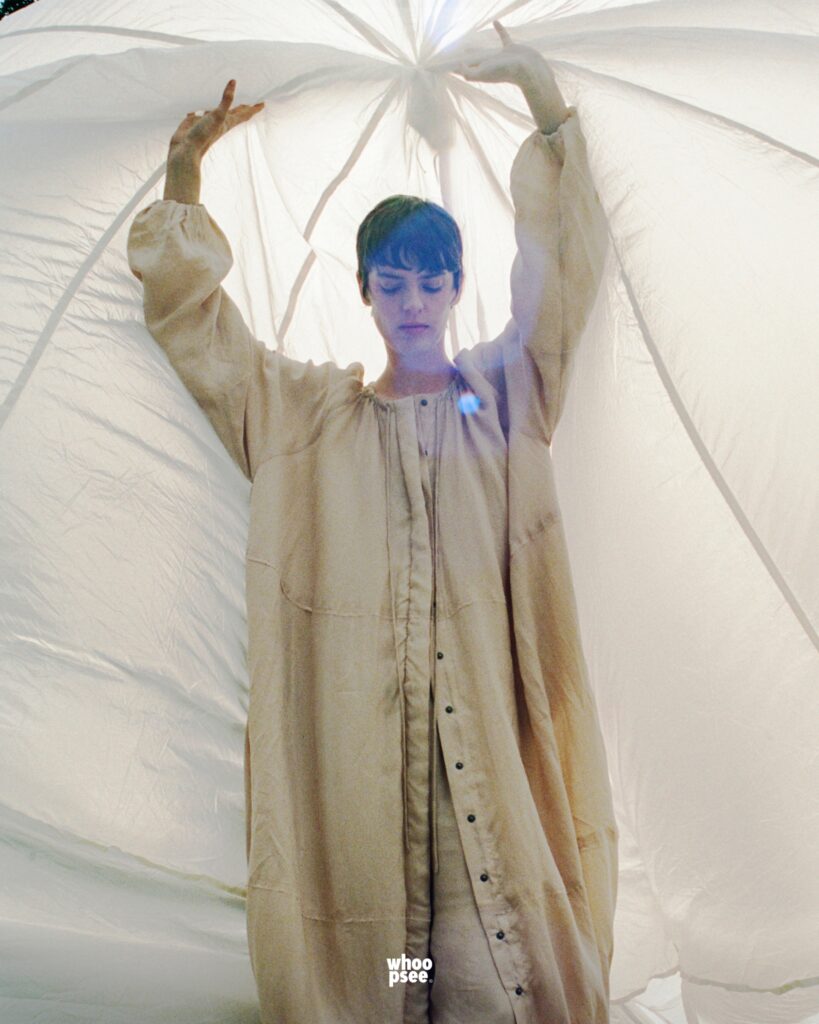
After more than forty years, perhaps Humanoid’s true strength lies precisely in its ability to keep a simple question alive: what remains when we strip away everything surrounding a garment—the advertising campaign, the marketing, the image? What remains is the person who created it. And the person who will wear it. And it is from this encounter—as simple as it is fragile—that Humanoid continues to build its story.
[📷 Courtesy of Humanoid]