Think of Edgar Degas’s dancers, captured in rehearsal rooms or on stage, wrapped in their tutus and depicted in a gesture suspended between dedication and dream. Preserved in paint or bronze, these young ballerinas symbolize a beauty that is light, fragile, and strong all at once—a beauty that transcends time. These young women, with their subtle femininity and the discipline of dance, have always fascinated artists and artisans for their ability to combine discipline and lightness, precision and movement, transforming the body into a form of absolute expression.
It is precisely this fleeting grace that Van Cleef & Arpels has chosen to capture through one of its most iconic creations: the ballerinas in High Jewelry. Since the 1920s, the Maison has cultivated a special bond with the world of dance. A ballet enthusiast, Louis Arpels used to accompany his grandson Claude to the Opéra Garnier, located just a few steps from the boutique on Place Vendôme. It was precisely this proximity that gave rise to a dialogue destined to stand the test of time, transformed from a precious memory into exquisite artistry.
The first Danseuse clips were created in the early 1940s and quickly became one of the Maison’s signature pieces. With their gold or diamond faces, precious headpieces, and tutus studded with diamonds or colored gemstones, these figures transform the movement of dance into a still composition that retains all its energy. Since 2007, the Ballet Précieux High Jewelry collection has reimagined this world through figurative and stylized creations inspired by the great ballets of the classical repertoire. Twelve ballerinas now make up an extraordinary corps de ballet, each with her own character, costume, and narrative universe: from Cléopâtre to La Sylphide, from Don Quixote to The Nutcracker, all the way to the most ethereal atmospheres of Ode.
To bring these figures to life, Van Cleef’s artisans draw upon a range of exceptional skills. Each ballerina is created from a model hand-sculpted in green wax using the lost-wax casting technique, which allows the artisans to study the volumes and capture the naturalness of the gesture in three dimensions. The wax is then transformed into a gold structure, which is subsequently refined, polished, and embellished with a selection of gemstones chosen by the Maison’s expert gemologists. Pleated gold, engraved or hammered gold, precious and ornamental stones: the materials become imaginary fabrics, capable of evoking the lightness of a skirt, the transparency of a veil, and the opulence of a stage costume. Through the work of its artisans, Van Cleef & Arpels portrays the ideal ballerina, captured in poses frozen in time, in an ode to dance itself—an infinite source of inspiration.
Let’s take a closer look at the twelve figures that make up this unique and precious ballet.
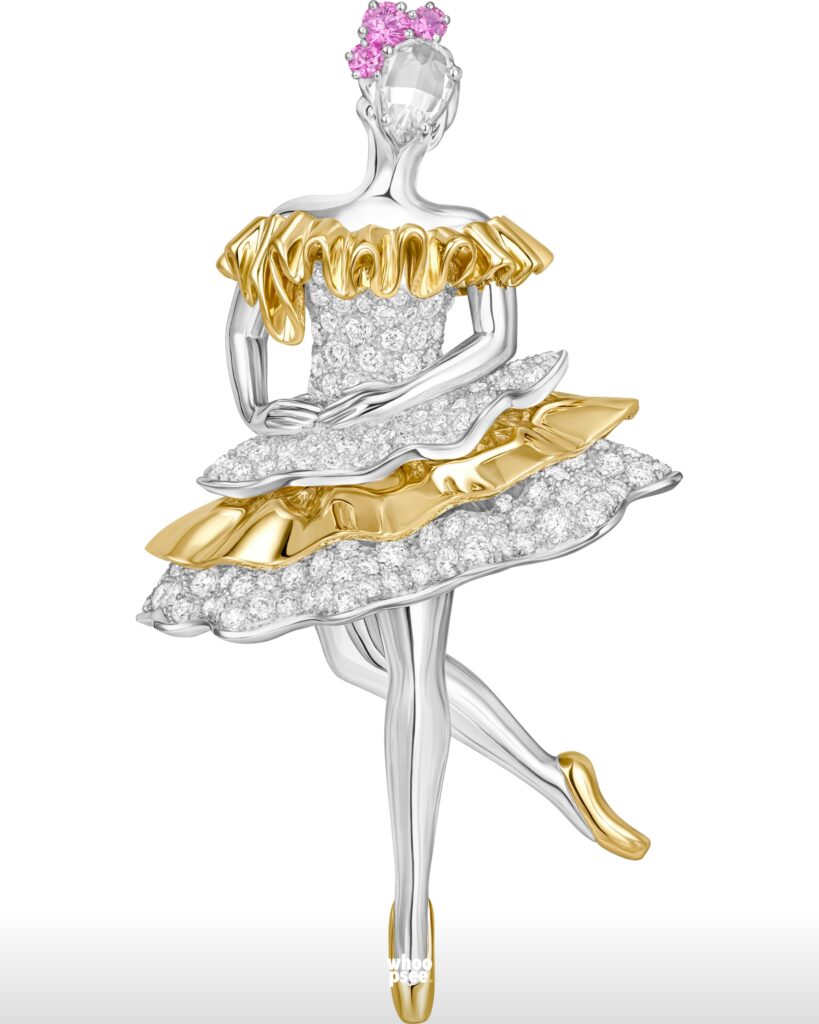
“Danse de Séville” Ballerina Clip
Inspired by the second act of Georges Bizet’s famous opera *Carmen* (1875), the clip depicts Carmen, the young bohemian, as she dances for her lover. The silhouette evokes traditional flamenco costumes through its layered skirts, which amplify the sense of movement. White and yellow gold are paired with diamonds and pink sapphires, chosen to illuminate the hem of the skirt and the headpiece with vibrant sparkles.
L’Esprit de la forêt Ballerina Clip
This creation pays homage to Marie Taglioni, who danced the lead role in the romantic ballet *La Sylphide*, choreographed by her father, Filippo Taglioni, in 1832 for the Paris Opera. The iconic elements of the dancer’s costume are reinterpreted in a luxurious style: gold wings embellished with diamonds, a decorated bodice, and a full tutu entirely encrusted with a pavé of colored gemstones. The suspended pose evokes the lightness of the famous sylph figure, while purple sapphires, tsavorite garnets, and rubies enliven the composition with intense chromatic accents.
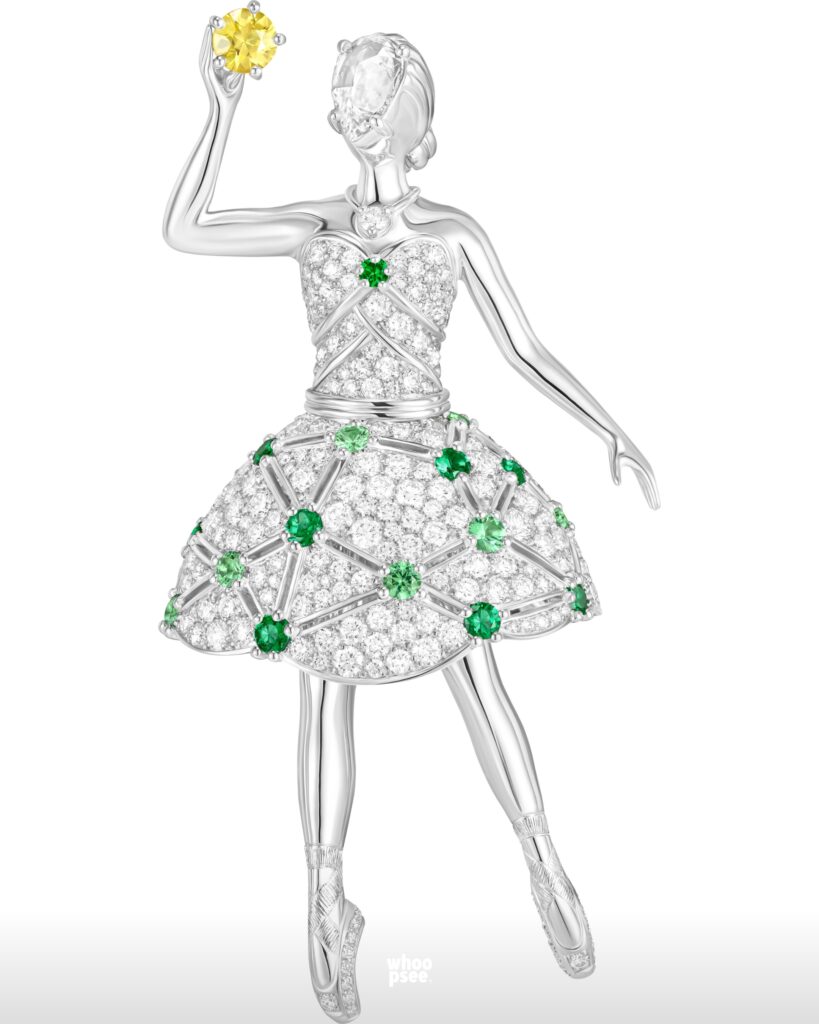
Perseide ballerina clip
Inspired by Ode, a ballet-oratorio choreographed by Léonide Massine for Serge Diaghilev’s Ballets Russes and presented in Paris in 1928, this ballerina evokes a celestial and modernist universe. Her contemplative pose seems to depict the delicate gesture of picking up a star. The performers’ soft gauze and crinoline dresses are translated into gold, while larger stones scattered across her silhouette recall the luminosity and order of the constellations.
Rêverie de Coppelius Ballerina Clip
Inspired by *Coppélia, ou la Fille aux yeux d’émail*, a ballet by Arthur Saint-Léon set to music by Léo Delibes (1870), this figure evokes the enigmatic charm of an animated mechanical doll. Her suspended pose evokes the precise movement of an automaton figurine, while the large bow in her hair and her gem-studded costume capture the character’s theatrical elegance. The colorful sleeves, crafted using the lacquer technique, contrast with the exquisite ruffle of the petticoat, embellished with sparkling stones.
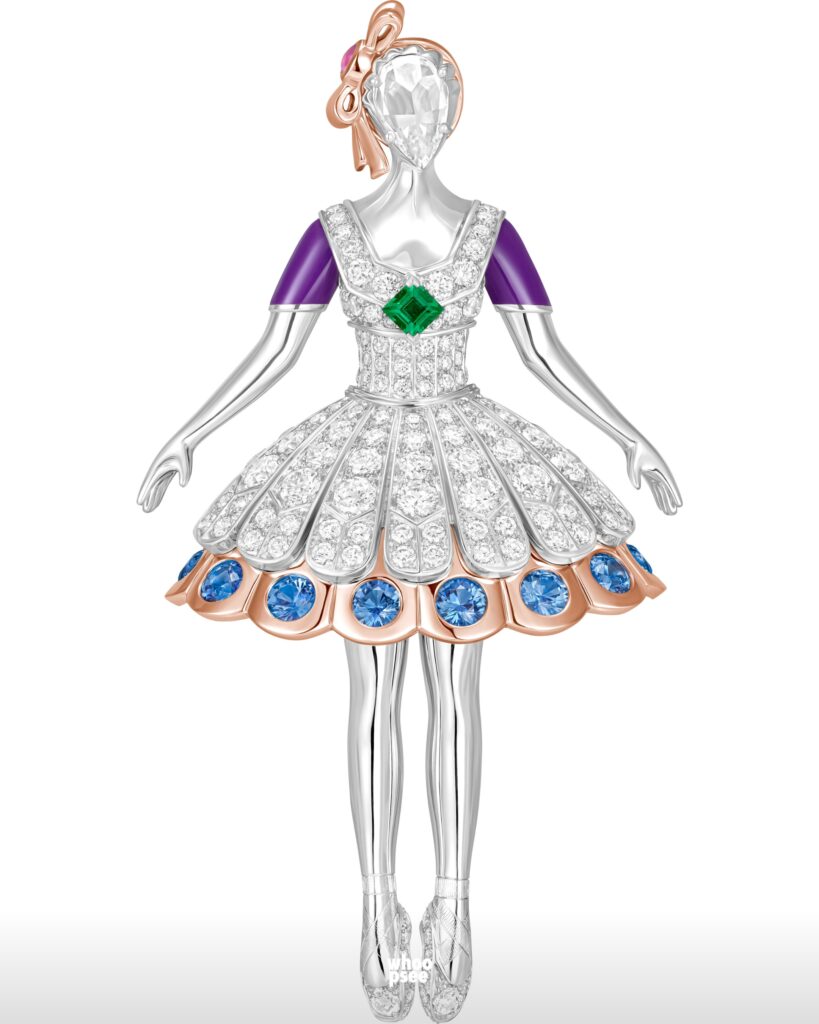
“Reine de Shemakhan” Ballerina Clip
The clip is inspired by Persian dance costumes and evokes the female lead character from Nikolai Rimsky-Korsakov’s opera *The Golden Cockerel* (1929). The figure’s ornate richness is expressed through a voluminous headpiece adorned with gemstones and gold motifs, an engraved collar, sleeves in colored lacquer, a diamond belt, and a tutu featuring gemstones in deep hues. A celebration of the cultural diversity that has always fueled the Maison’s imagination.

Armide Ballerina Clip
Inspired by the female lead of the ballet *Le Pavillon d’Armide*, created by Michel Fokine in 1907, this piece captures the character’s grace and refinement through a harmonious blend of precious materials. Polished and engraved gold is paired with gemstones in delicate hues, selected by the Maison’s expert gemologists. The combination of rose gold and white gold is made possible by the épargne technique, which protects the metal and gemstones during the rhodium-plating process. A finely engraved motif adorns the edge of the underskirt and the sumptuous headpiece.
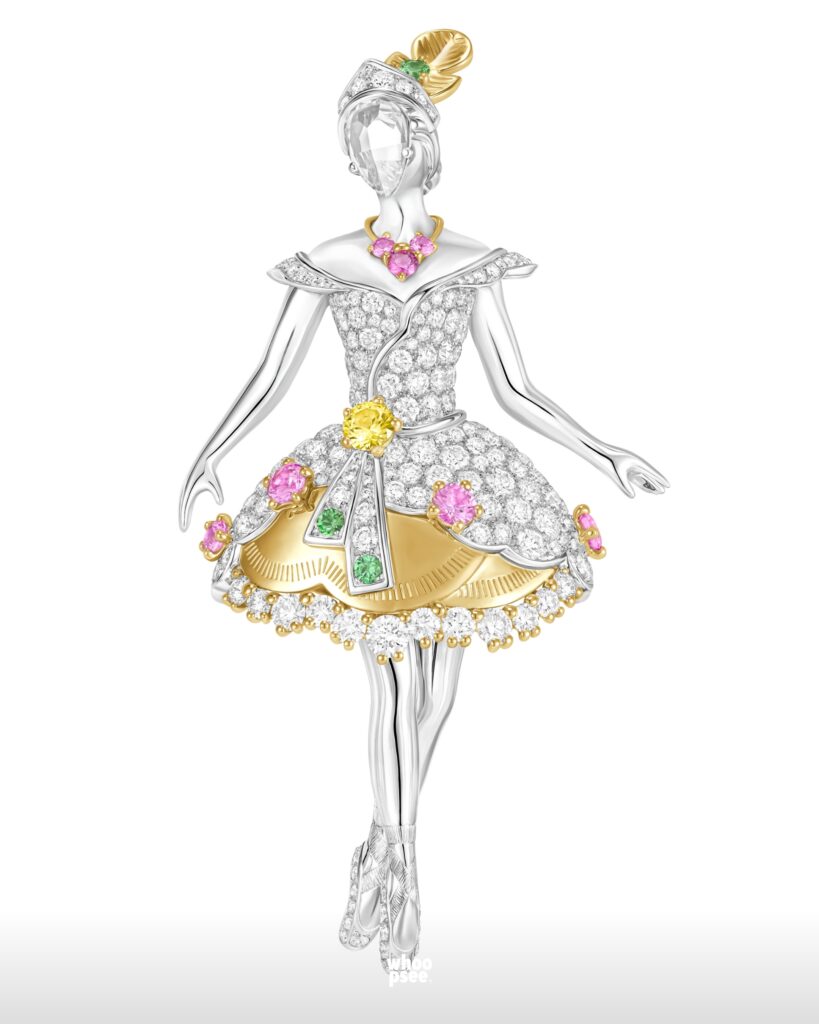
Belle de Songe Ballerina Clip
Inspired by Alexandre Glazunov’s *Raymonda*, Op. 67, choreographed by Marius Petipa, this ballerina captures the elegance and boldness of ballet through a refined interplay of materials. The textured surface of the hammered gold contrasts with the brilliance of the diamond pavé, while closed-bezel cabochons and faceted stones introduce touches of intense color, evoking the opulence of the stage costumes.
Rose de Bengale Ballerina Clip
Perched on its tips, the clip seems to capture a ballerina in the midst of a relevé, suspended between balance and movement. The design pays homage to the splendor of ancient India through a costume rich in precious details. On the diamond-encrusted bodice, scrollwork and gold pearls meet cabochons of colored gemstones, while the shape of the skirt echoes the motifs of oriental screens. The figure represents the goddess Amravati, the protagonist of Marius Petipa’s ballet *Le Talisman* (1889), transformed into a rose.

Masha Ballerina Clip
This clip depicts Masha, also known as Clara, transformed into a princess in Pyotr Ilyich Tchaikovsky’s fairy-tale ballet *The Nutcracker*. As if ready to step into a waltz, the ballerina wears a gown that celebrates the Maison’s signature gold craftsmanship. The metal, crafted using the guilloché technique, evokes the texture of fabric, while pear-shaped gemstones of varying sizes and rows of pavé recall the delicacy of lace. A pendant echoes the colors of the gemstones adorning her pointe shoes.

Fée Dragée Ballerina Clip
Inspired by the third act of *The Nutcracker*, a fairy-tale ballet created in 1892 to music by Tchaikovsky, this figure represents the Sugar Plum Fairy, who welcomes Masha and her prince to the enchanted kingdom of Confiturembourg. The design stands out for its delicate harmony of pastel shades. The headpiece is adorned with colorful gemstones, while the tutu combines polished and engraved gold with scalloped petticoats and pavé settings of diamonds or gemstones in soft hues.
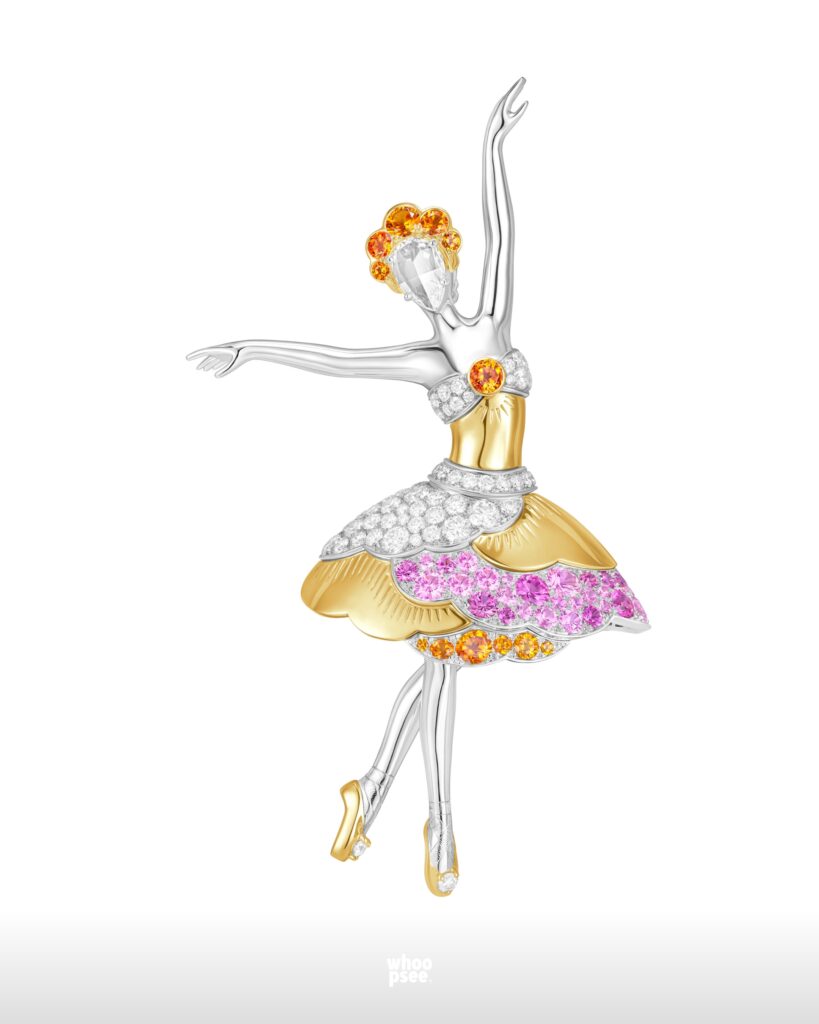
Castilla Ballerina Clip
From the open fan to the “attitude” pose, this clip evokes the Spanish dances reinterpreted in Rudolf Nureyev’s ballet *Don Quixote*. The ruffled sleeves, crafted from gold threads, accentuate the dynamism of the movement, while the polished gold corset, adorned with a row of diamonds, is paired with a skirt built up in layers of volume and sparkling gemstones. The ensemble captures the rhythmic energy of a ballet set in traditional Spain.

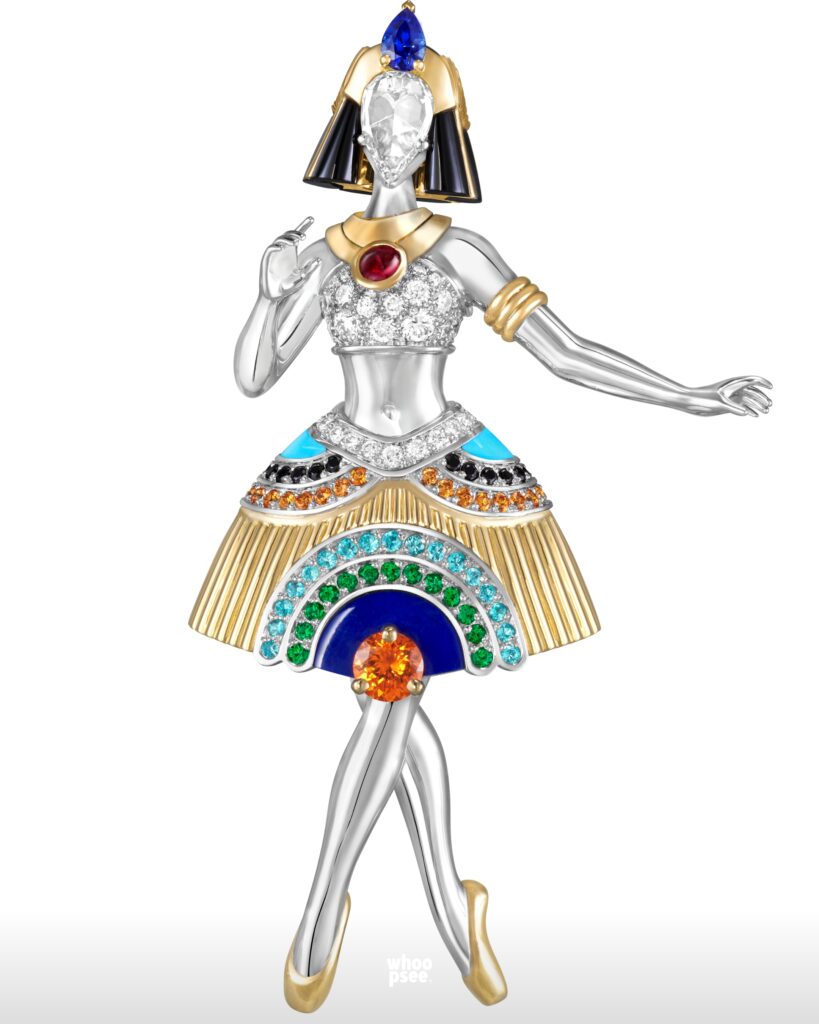
Cléopâtre Ballerina Clip
This creation reflects the fascination that Pharaonic Egypt has held for the Maison’s imagination since the 1920s and is inspired by the opera by Jules Massenet. The ballerina evokes the elegance of ancient queens through a headpiece crowned with a pear-shaped gemstone, a pectoral necklace, bracelets, and a godron-patterned gold skirt. Precious, fine, and ornamental gemstones come together in a composition of rich, sophisticated colors, evoking the splendor of ancient Egyptian jewelry sets.
In 2020, the deep connection between Van Cleef & Arpels and dance found further expression with the launch of Dance Reflections by Van Cleef & Arpels. Driven by the values of creation, transmission, and education, the program reflects the Maison’s desire to support artists and institutions in promoting the choreographic heritage, while also fostering the emergence of new visions and contemporary forms of expression. Since its inception, Dance Reflections has partnered with numerous companies in the production of their works and supported various institutions in presenting them on the world’s most prestigious international stages. This commitment is renewed each year through dedicated events, including the Dance Reflections by Van Cleef & Arpels Festival, which brings together artists and audiences to celebrate the richness and ongoing evolution of the art of dance. In addition to supporting the creation and presentation of works, the program places a central emphasis on the transmission of knowledge and the accessibility of dance culture. Through residencies for professional dancers and outreach initiatives open to all, Dance Reflections helps preserve this living heritage, fostering its sharing and reinvention.
The story linking Van Cleef & Arpels to dance thus emerges as one of profound affinity, cultivated over time through creation, transmission, and continuous reinvention. Like any authentic bond, it does not end with a contemplation of the past, but finds new life in the present and in visions of the future. From ballerinas sculpted in gold and precious stones to the fleeting movements that continue to bring stages to life, the Maison celebrates the same pursuit of grace, balance, and beauty. An endless dance, in which the art of jewelry meets the art of movement to preserve what, by its very nature, would seem destined to fade away: the grandeur of a perfect moment.
[📷 Courtesy of Van Cleef & Arpels]