There’s a moment every summer when I find myself longing for a vacation that doesn’t actually exist. It’s not a specific destination, nor a hotel to book, nor a hidden beach to reach before everyone else discovers it. It’s more of a feeling. A light. A way of spending my days. I’d like to experience a summer à la Éric Rohmer.
It’s curious how such an influential director has remained, at heart, something of a well-kept secret. For film buffs, Éric Rohmer is one of the great masters of the Nouvelle Vague, an essential filmmaker capable of revolutionizing the language of cinema with an almost imperceptible elegance. Yet he never truly became mainstream. His name isn’t mentioned as naturally as those of other great French directors; his films aren’t constantly referenced in popular culture; they haven’t entered the pantheon of works that everyone pretends to know. And perhaps that is precisely his strength. Rohmer continues to be a personal discovery, a word-of-mouth recommendation among friends, a love that almost always comes about by chance and that, once encountered, changes the way you look at cinema. Or perhaps, even more so, it changes the way you look at summer. Because his films aren’t simply films. Today we’d say they’re a mood, a vibe, a perfectly recognizable aesthetic. But even these words seem reductive. Rohmer’s universe is something more complex: it’s a philosophy of slowness, an invitation to observe what we normally overlook. In his stories, no major events take place; there are no chases, no plot twists, and no declarations of love in the rain. There are endless conversations, aimless strolls, and sun-drenched afternoons when it seems as though absolutely nothing is happening. And yet, when the film ends, you realize that everything has happened. The protagonists have changed, often without even realizing it; they’ve discovered something about themselves, they’ve longed for the wrong person, they’ve pursued an idea of love rather than love itself. Just as happens in life.
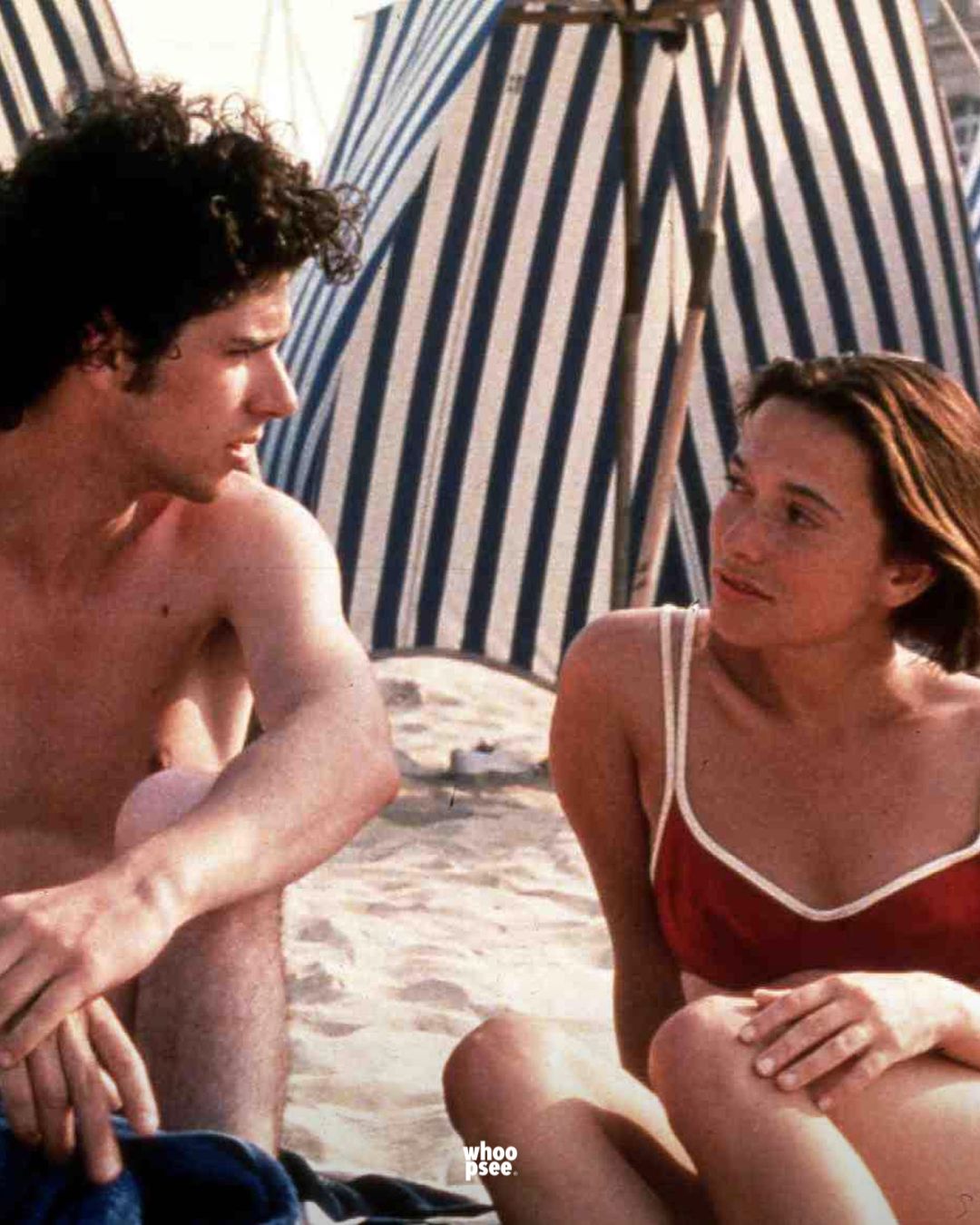
This is the magic of Rohmer: transforming the ordinary into something extraordinarily poetic, like accidentally brushing against a knee, as in *Le genou de Claire*. Watching one of his films means slowing down the pace of your thoughts, accepting that a scene can be filled entirely by two people talking while sitting on a beach or strolling along a coastal path. It means understanding that the sound of the wind in the trees, the light shifting throughout the afternoon, and the silence after an unanswered question carry the same narrative weight as any dialogue.
Perhaps this is also why, in recent years, its imagery has been rediscovered by a generation that had never really been familiar with it. On Pinterest and Instagram, collections of images are proliferating that seek to imitate that milky light, those linen clothes, those terraces overlooking the sea, those café tables where time seems to have stood still. People are constantly talking about the “Rohmer girl” and the “Rohmer summer,” as if a scarf in your hair or a bicycle leaning against a white wall were enough to step into his world. But the point is that Rohmer has never been just an aesthetic—he’s a way of seeing.
And it’s a perspective that spans decades without losing its freshness. You need only line up three of his most famous summer films—*The Collector*, *The Green Ray*, and *A Summer’s Tale*—to realize how little time, ultimately, changes when it comes to desire. *The Collector*, released in 1967, is perhaps Rohmer’s first great manifesto of summer. There is a villa on the French Riviera surrounded by lush vegetation, the sea almost always visible in the background, and the heat that slows every movement. Adrien would like to spend a summer devoted to rest, books, and leisure. But the arrival of Haydée—a free-spirited, magnetic young woman who cares little for others’ judgments—immediately disrupts that apparent balance. On the surface, almost nothing happens: they sunbathe, dine together, chat, and observe one another. Beneath that calm, however, desires, jealousies, and contradictions stir. Rohmer doesn’t film the action; he films what precedes it. The moment when a feeling is born, changes shape, or contradicts itself. It is cinema made of nuances, where even silence seems to say something.
Twenty years later came *The Green Ray*, probably her most melancholic film and, today, also the one most beloved by younger generations. Delphine is unable to leave with her friends; she constantly changes her destination, wandering from one seaside resort to another, feeling out of place everywhere. She is a fragile protagonist, unable to feign enthusiasm, intolerant of small talk, and constantly searching for something she cannot even name. Anyone who has ever experienced a summer where everyone else seemed to be having fun except for us recognizes that feeling. Rohmer portrays a loneliness that never becomes a tragedy, nor is it merely melancholy. It is a state of limbo. Delphine waits for a sign, and that sign will indeed arrive in the form of the extremely rare green ray that appears for just a few moments at sunset. A natural phenomenon transformed into a metaphor: happiness exists, but it appears only when we stop chasing it so stubbornly.
Then, in 1996, came *Conte d’été*, perhaps the film that more than any other embodies what we now call a “Rohmer-style summer.” There’s Brittany, with its sun-drenched beaches and the wind that never stops blowing. There are bookstores, small cafés, long walks along the waterfront, and afternoons spent with no plans at all. Gaspard arrives on vacation waiting for his girlfriend, but in the meantime he meets two other girls. He can’t make up his mind; or rather, he can’t figure out what he really wants. As is often the case in Rohmer’s films, the focus of the story isn’t the love triangle, but uncertainty. It’s that age when every possibility still seems open, and precisely for that reason, it becomes difficult to choose one. By the end of the film, you feel as though you’ve spent an entire summer alongside the characters, even though nothing particularly dramatic has happened. And it is precisely this impression that makes Rohmer’s cinema so unique: the feeling of having lived through that time rather than simply having watched a story unfold.
His characters also contribute to this sense of authenticity. Rohmer was wary of overly contrived acting. He preferred to work with up-and-coming actors and, often, with ordinary people, convinced that they had not yet been “tainted” by the conventions of academic training. He sought genuine hesitations, imperfect smiles, and dialogue that seemed to arise spontaneously. That’s why no one in his films comes across as theatrical. No one delivers memorable lines with the intention of becoming iconic. They interrupt each other, contradict one another, talk too much, and change their minds. They seem like people who exist even when the camera stops rolling.
And perhaps this is exactly what I keep chasing when I think of a Rohmer-style summer. Not France itself, even though Paris in August, Brittany, the French Riviera, or the small towns of the South have certainly helped shape that myth. Not the linen shirts, the wicker chairs, the open windows, or the bright houses with white walls—though they, too, have become part of an unmistakable imagery. What I truly long for is the rhythm of his days. A summer without the obsession to do everything, see everything, and photograph everything. A summer where you can afford the luxury of getting bored, of changing plans at the last minute, of spending three hours talking to someone you’ve just met without constantly checking your watch. A summer where time isn’t measured by the number of things we do, but by the quality with which we experience them.
We live in an age that convinces us that every vacation must turn into a perfect story to be shared online. We book restaurants months in advance, chase down spots that have gone viral, and plan each day as if it were a to-do list of goals to check off. Rohmer, however, reminds us that the most memorable summers are often the ones that had no plan at all. The ones where an afternoon stretches into evening without us even noticing. The ones where a conversation changes the course of a relationship more than any grand gesture. The ones where we learn that even time that seems wasted can be the most precious of all. Perhaps this is why, every time I watch one of his films again, I feel a very strange sense of nostalgia. Not for a place I’ve been or an era I’ve lived through, but for a version of summer that seems to belong to a different idea of happiness. A quiet, unassuming happiness, made of natural light, words, wind, and anticipation. A happiness that doesn’t need to be spectacular to be unforgettable.
So yes, if someone asked me how I’d like to spend next summer, I probably wouldn’t mention an exotic destination or a beach resort. I’d simply say I’d like to experience it the Rohmer way: with the slow pace of his afternoons, the uncertainty of his romances, the lightheartedness of his strolls, and that extraordinary ability to find the infinite in the smallest things. Because, after all, the greatest lesson of his cinema is precisely this: beauty isn’t hidden in exceptional events, but in the life that keeps flowing even when we think nothing is happening.
[📷 IPA]