Piero Portaluppi is perhaps the architect who best embodies the spirit of Milan: elegant yet severe, cultured yet pragmatic, capable of holding together historical memory and momentum toward the future. His architecture eludes any unambiguous definition. Art Nouveau, Deco, twentieth century, rationalism, classical monumentality: all these categories seem to brush against his works without ever really being able to contain them. In a single building, Renaissance quotations, modernist geometries, refined decorative details, and rigorous compositional clarity can coexist. It is precisely this tension between opposites that makes his language so recognizable: eccentric but disciplined, sophisticated but never redundant, profoundly Milanese in its ability to combine measure and invention.
For a long time critics have looked askance at this elusive nature, sometimes accusing him of formalism. Yet what makes his work unique is precisely the freedom with which he traverses epochs and styles without belonging completely to any of them. In the period between 1930 and 1935 the most evident turning point takes place: Portaluppi gradually abandons the historicist echoes and the more Art Deco ornaments in favor of a more modern, rationalist syntax. But even in his most modernist phase he never entirely renounces decoration, the theatricality of space, and a taste for precious detail. Modernity, in him, never becomes cold, and that is what sets him apart, which is why I, like many, love him.
The beauty of his architecture stems precisely from this dual matrix: on the one hand, technical, almost engineering precision; on the other, a poetic and visionary sensibility. Even when he uses luxurious materials and opulent details, the result never appears excessive. His decorum is discreet, subtle, almost edgy. Lines always maintain a controlled rigor, while richness emerges in contrasts, surfaces, and light. This is why his modernism appears today as a form of warm minimalism, and his art nouveau accents acquire a contemporary sharpness. In the international architectural scene, Portaluppi remains a figure difficult to assimilate to any current: absolutely unique.
Born in Milan on March 19, 1888, the son of a construction engineer, Portaluppi graduated from the Politecnico in 1910 with a gold medal as best student of the year. From the beginning, an out-of-the-ordinary personality emerged: rigorous designer, but also ironic draughtsman, author of caricatures and passionate collector of sundials, a symbol of his almost obsessive relationship with light and time. His first assignments came far from the city, in the Alps, where he designed hydroelectric power plants for his father-in-law Ettore Conti. Even in these industrial architectures he manages to transform technique into elegance, blending functionality and aesthetic research in a surprisingly modern way. In the 1920s his destiny became definitively intertwined with that of Milan, then a city in the midst of transformation. Portaluppi soon became the architect of the great entrepreneurial bourgeoisie, designing villas, palaces and private residences that still define the imagery of Milanese elegance. But his work is not limited to the refined interiors of the elite: he also intervenes on public buildings, restorations and symbolic places in the city, leaving a deep mark on the face of Milan.
Among his most famous works is certainly Villa Necchi Campiglio, built between 1932 and 1935. It is the perfect manifesto of his idea of modernity: a technologically avant-garde house for those years, with a private pool, dumbwaiter, intercoms and armored vault, but at the same time intimate and and elegant. Rationalist rigor is softened through woods, marble, warm surfaces and light calibrated with extraordinary sensitivity. The interiors hold French Louis XV furniture, English silverware, tapestries, oriental porcelain and lapis lazuli tables, composing a very rare balance between luxury and measure. Even today, the villa retains its original domestic character intact, as if time had stood still. Not surprisingly, it has become one of the city’s most beloved places, the site of FAI events and the setting for Luca Guadagnino’s film Io sono l’amore starring Tilda Swinton. To this day, Villa Necchi also holds the archive of Portaluppi’s work, donated by the foundation of the same name to FAI and now collected in the villa’s wonderful spaces.
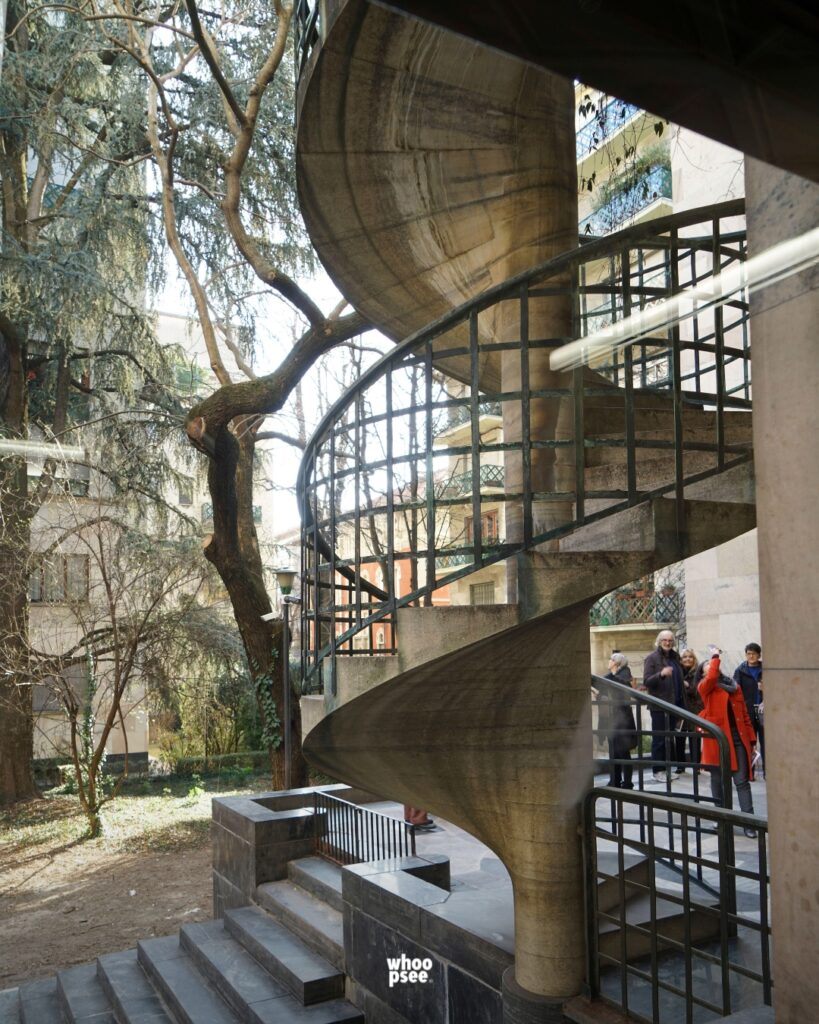
Another masterpiece is Casa Corbellini-Wassermann, on Viale Lombardia. The pink and gray marble facade perfectly sums up Portaluppi’s style: essential yet precious, rigorous yet sensual in its materials. Inside, the famous spiral staircase wraps around the space like a sculpture, traversed by natural light, and green marble traversed by veins alternates with wood in cali tones. Every detail is designed to transform living into a total aesthetic experience, and today, thanks to the presence of the Massimo De Carlo Gallery, it is still possible to visit the space and the refinement of the interior.
In Palazzo Crespi, between Corso Matteotti and Piazza Meda, Portaluppi instead interprets the more solid and institutional face of the Milanese bourgeoisie. Built between 1928 and 1932, the palace combines monumentality and lightness through its large serliana portico and the broken gable that lightens its verticality. Every proportion is calibrated with mathematical precision, but the result does not appear rigid: the decoration remains measured and harmonious, perfectly integrated into the whole.
More intimate and personal, on the other hand, is Casa degli Atellani, an ancient 15th-century residence that Portaluppi restored and also transformed into his own home. Here his approach to the past emerges with extraordinary delicacy, accentuating the historic traces of the environment: the original arches, serizzo corbels, and references to 15th-century Lombard architecture coexist with modern details and his unmistakable decorative taste. Portaluppi also redesigns the famous Vigna di Leonardo, creating a place suspended between the Renaissance and the 20th century, where time seems to stratify.

Even in the restorations Portaluppi demonstrates a rare balance. The interventions at the Pinacoteca di Brera improve museum functionality without altering its historical atmosphere: the rooms become more rational, brighter, and more modern, but the architecture never overpowers the works: it silently accompanies the experience of space and art. On the Corso Venezia front is the monumental Palazzo della Società Buonarroti-Carpaccio-Giotto, built between 1926 and 1930. The large theatrical entrance arch, U-shaped plan, and bright inner courtyard tell of an elegant and cosmopolitan Milan. Here Portaluppi’s language blends Secessionist suggestions and Art Deco geometries in a refined balance, with interior decorations on the archway resembling a trompe l’oeil.
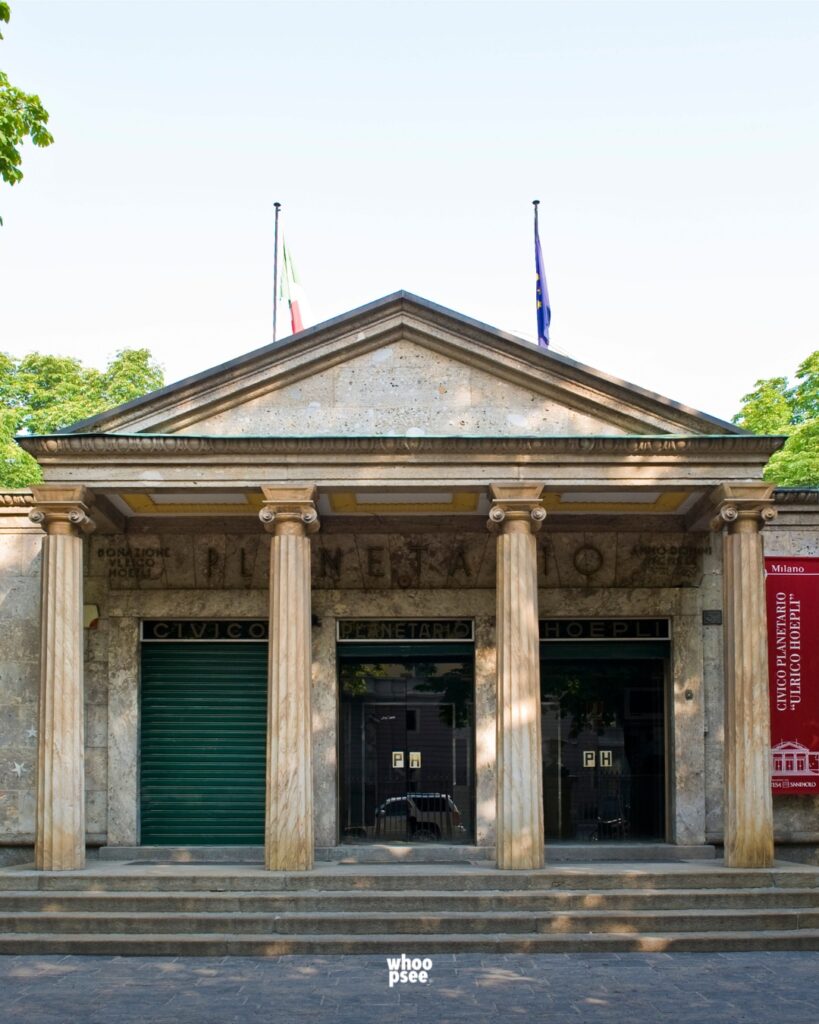
Finally, the Hoepli Planetarium, a few steps away from the Palace, represents perhaps the most poetic side of its research. Inaugurated in 1930, it is conceived as a true temple of science: octagonal plan, hemispherical dome, Ionic columns and astronomical decorations accompany the gaze toward the sky. Here, mentioned last, Portaluppi once again succeeds in the feat that runs through all his work: making classicism surprisingly modern and modernity incredibly human.
[📷 IPA]