That Kim Kardashian likes to amaze at every Met Gala is a well-known fact. After wearing a Balenciaga morphsuit that entirely covered her body and face in 2021, slipping into a Marilyn Monroe gown in 2022 with all the criticism, and sporting a textbook wet look by Mugler in 2019, for 2026 the entrepreneur and founder of Skims is back on the steps of the Metropolitan Museum in New York with a look that, seemingly, might appear to be an ode to the female body shape-which would make it perfectly in line with her brand’s philosophy-but actually carries with it a much more important and profound visual legacy.
An armor dress, a corset-sculpture that does not simply emphasize natural curves, but reworks the body, which is framed and presented as a truly constructed form. Behind the sculptural approach of this daring look is one of the most emblematic, provocative and controversial artists ever: Allen Jones. In fact, the British artist collaborated with designer Whitaker Malem – an expert in leather goods and thus the creator of Kim’s ensemble skirt – to bring back, through one of the most influential women of our time, his artistic poetics, which from the 1960s to the present day continues to imprint itself in the collective imagination as disturbing but also extremely necessary.
Born in 1937 in England, Jones was trained in the fertile climate of British Pop Art, alongside names such as David Hockney and Peter Blake, but from early on he took an edgier and more ambiguous direction, playing on the relationship between desire, consumption and the representation of the body. His career explodes in the 1960s, when Western visual culture is invaded by advertising, cinema and a new aesthetic of seduction. These are the years when the economic boom is reflected in an optimistic climate that, well before the feminist uprisings, does not foresee an effective redemption for women, considered primarily for their physicality. The more attractive the body, the more the woman is seen not in her human dimension, but as an object, a status symbol.
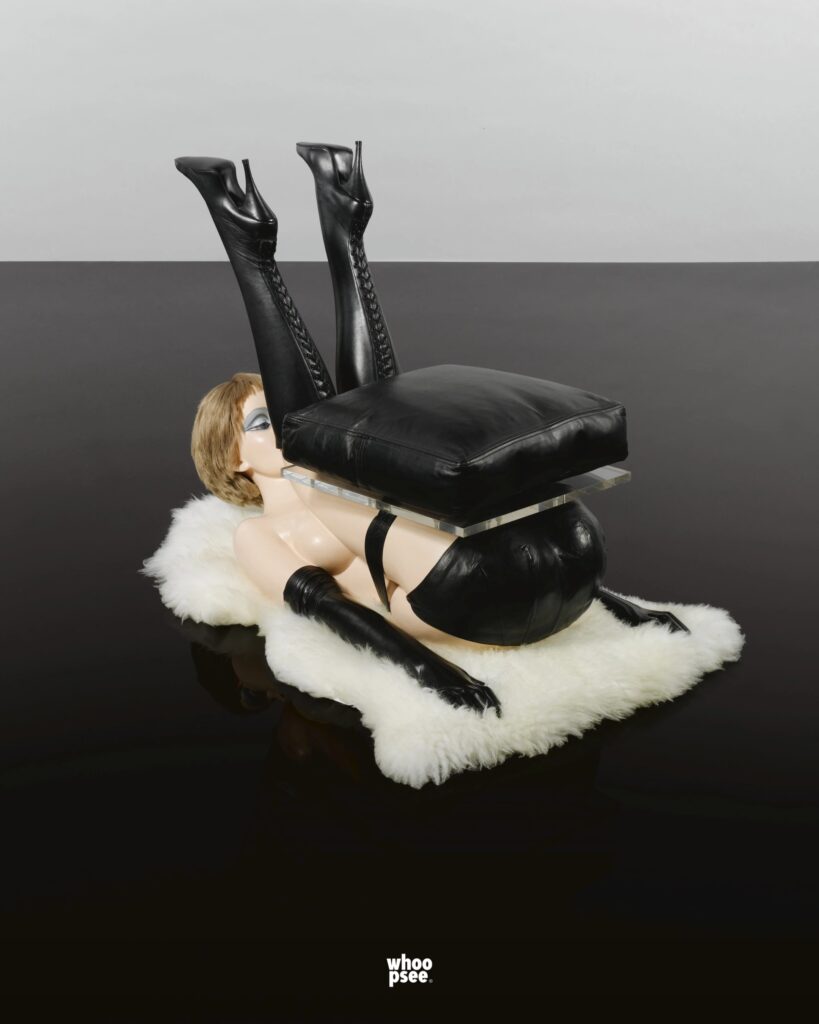
Jones intercepts all this and translates it into an artistic language that chooses to deliberately denounce this process of commodification through explicitly erotic, provocative, for some even vulgar suggestions. His most famous works, namely furniture-sculptures such as Chair, Table and Hatstand, transform the female body into a functional object, fetish and symbol of an imaginary dominated by the male gaze. It is no coincidence that these works have generated fierce controversy: for some they are a sophisticated critique of the social scourge of the objectification of the body, for others an unfiltered perpetuation of it.
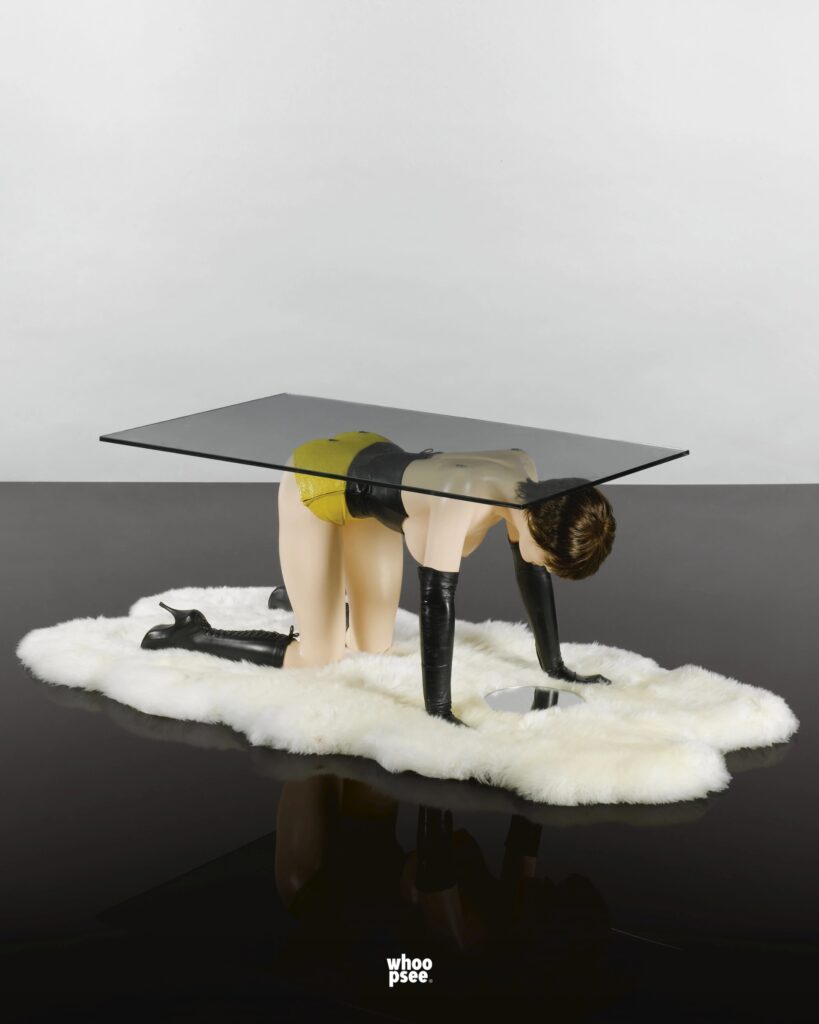

Many of his works draw on the imagery of bondage, fetish and BDSM: Jones takes female mannequins with heavily made-up faces, puts wigs and S&M outfits on them. These same mannequins become seats, coffee tables, and coat racks. They stimulate the most perverse fantasies of men who, in the seemingly passive representation of femininity, pour thoughts of submission and voyeurism into these art objects.
Jones has been and continues to be an inspiration to many: the erotic sculptures in the Korova Milk Bar we find in the film A Clockwork Orange are clearly a reference to his work, after the artist turned down Stanley Kubrick’s offer to work on the film’s set design for free. In return, Jones collaborated on the design of the 1975 arthouse erotic film Maîtresse, the real visual inspiration for Kim’s look at the Met. Rick Owens, famous for his store seat-sculptures, drew right back to Jones in his realistic and deliberately disturbing approach. In some ways, we could say that Bianca Censori’s interior design collection is also an homage to the British artist’s work, with seats and tables that realistically reinterpret the body of the architect and Kanye West’s partner.
Jones has always been perceived as an uncomfortable artist, but his is not provocation for its own sake, but a naked and raw manifestation of contemporary, sex-dominated society. To do so he constantly treads the line between criticism and complicity, and this ambiguity is the key to his longevity. Jones does not ask to be liked, nor does he wish to please: his works brutally place before the eyes of the viewer a truth that may be uncomfortable to accept, but which has long involved Western culture. His real legacy lies in the way he forced audiences to confront a disorienting question: where does representation end and exploitation begin? A question that today, in the age of social media and hyper-exposure of the body, resonates perhaps even louder than in the early 1960s and cannot leave one indifferent.
[📷Instagram: allenjonestheartist; Sothebys.com].