There are professions that teach you to look at the subject beyond the symbol. One of these is undoubtedly that of the florist. Flowers are indeed living matter, unpredictable, inevitably linked to something greater than the gesture that makes it up. This awareness is a subtle shift in consciousness, but it completely changes the way you approach any creation, from the smallest of bouquets to the most scenic installations.
In Lucy Button’s work this awareness is very much present. Lucy works at McQueens Flowers, an upscale floral studio based in London, known for large-scale projects-corporate events, hotels, luxury brands-where compositions become almost architecture and the art of flowers crosses different realms. Their style is built, recognizable, classical and opulent: full flowers, dense textures, a strong sense of visual control, and a strong focus on education. In addition to services for private clients or companies, McQueens is one of the few in England to offer real courses and workshops, which can indulge simple passions but can also stimulate and develop a real career path, offering certificates that guarantee participants then a continuation in the world of floral arrangements. Lucy is one of the teachers, and she really enjoys this aspect of her work, which, as she tells me, keeps her in a perpetual state of learning and growth, stimulated by exchange.

Yet even in such a defined context, the material one works with remains inherently unpredictable, since it is living matter. I smile as I think back to another interview I conducted recently, that with the ‘cake wizard’ Sophia Stolz. Lucy’s words, as she tells me about her relationship with flowers and plants, are very similar to those that Sophia uses when she talks about the organic matter that she then goes on to bake: in both cases you are working with your hands, you are going to mold something alive, creating something new from matter that is already pulsating in itself.
Lucy’s journey helps to understand how this tension is held together. On the one hand there is practical experience, which began very early in her grandmother’s store, where the relationship with flowers is direct and instinctive. On the other is study, which came later, at Hadlow College, where she studied botany, agriculture and floral design in depth. This was a valuable experience for her, adding a grammar to something that already existed, making her work more conscious, made of a maturity also conceptual and linguistic, as well as practical.
Her professional choice has always been accompanied by a deep awareness: ” working with flowers means dealing with emotions,” Lucy tells me. And again, as in the case of Sophia’s cakes, I dwell on the truth of her words, and how charged with symbolism they both are. Across eras and cultures, flowers are indeed always linked to emotionally charged moments: birthdays, graduation parties, weddings, celebrations, births, but also losses, and they carry with them all that words cannot say. Therefore, for those like Lucy who speak through them, every composition starts with deep listening. Understanding the context, the intentions, the expectations, so as to translate them into something that works visually but also manages to reach its recipient symbolically.
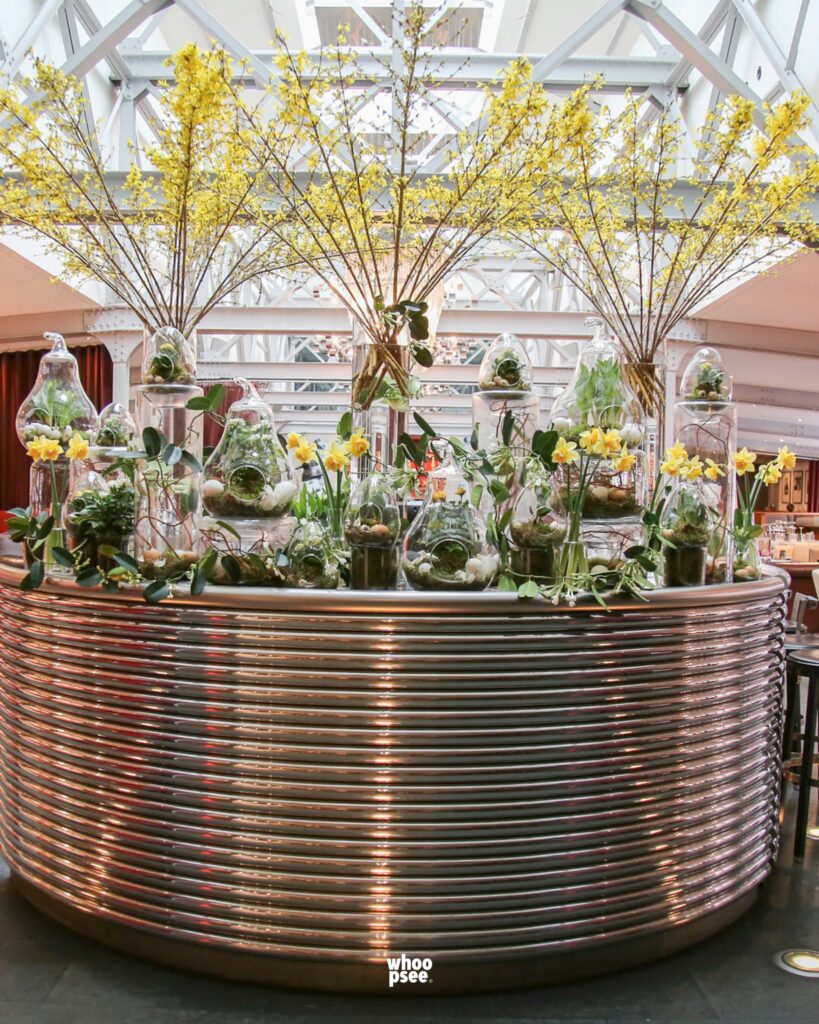
At the same time, however, this process is never completely under control. Flowers arrive from complex supply chains, often passing through the Netherlands, and what you receive is never identical to what you imagined. A variety may be slightly different, more open, more fragile, with an unexpected hue. That’s part of the job. More than correcting these variations, you have to absorb them, incorporate them into the composition. The unknown is a structural component of living matter: when working with the organic, control is a secondary factor, and it is valuable to learn to embrace the unknown.
And then, intrinsically related to this, there is the question of duration. Flowers have a fragile and obvious temporality: they are born, reach a moment of full expression, and then begin to die. Even in McQueens’ most spectacular installations, this trajectory is implicit from the beginning. Decay makes the delicacy of the material even more sensitive, and Lucy’s work even more complex. This is because another component is introduced to the work: transformation. An interesting aspect is also understanding what happens to these flowers and compositions after the pulsating focus of the occasion. Lucy tells me that after an event, the flowers can be donated, reused, or turned into compost (McQueens is affiliated with a company to which it donates its waste to make compost), but either way, as Lucy rightly tells me with a smile, “they always find a new life.” Perhaps this is the most interesting aspect: working with flowers means constantly moving between structure and loss of control, between life, growth and decay. You can design, order, build-and within McQueens this happens at a very high level-but there always remains a part that escapes, a living component that transcends control and then takes over in the lives of those who encounter them. Guests, celebrants, families celebrating children or saying goodbye to loved ones.
Lucy has made arrangements for very different clients. Among the most significant memories is her participation in the floral installations for Prince Harry’s wedding, undoubtedly one of the highlights of her career, which began when she was still very young and is now more than a decade old. Yet, when I ask her what the real honor was, her answer changes tone. She does not talk about big events or visibility, but about funerals. She tells me this with disarming simplicity and gentleness, because in those moments flowers are not meant to impress, but to accompany, to hold together something that is ending. And, undoubtedly, the teaching: sharing what she has learned over the years with people who want to learn and possibly even grow a business in the industry, as she tells it, brings her great joy, in a continuous exchange that increases knowledge on both sides.
And on this note the value of Lucy’s work is summed up: the beauty of dealing with organic matter, with its fragility, and the deep joy of making something special for those who remain.
[📷 Courtesy of McQueens flowers]